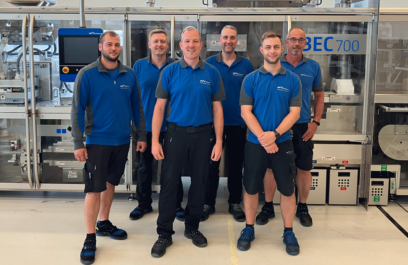
Wolfang Krahl and his colleagues already know how certain components will work on the Uhlmann machines before they even exist. They may not have a crystal ball, but they do have another pretty powerful tool to work with; it’s called simulation. They also perform tests on the machine to ensure that the process is optimally matched to the equipment. Three simulation engineers and five process engineers work together in the Process and Simulation team – along with Wolfang Krahl, the team leader.
Krahl himself is a simulation engineer and has been with Uhlmann since September 2000. “Three years ago, the two teams of Process Technology and Simulation were merged. This makes sense, as we can also use simulation models to check process technology issues,” explains Krahl. “We model hypotheses about how a process works in the simulation and compare them with the hard test on the machine, and then we can see whether it really does work as intended.” While one part of the team mainly works on the PC in the office, the other is usually running tests on the actual machine.

“The Process and Simulation team acts as a service provider for the entire company, so the interfaces with other departments are correspondingly diverse. Wolfgang Krahl explains: “Our job includes working on development or design projects, but we also come into play when it comes to preparing a quote for a concept where the functions need to be analyzed in more detail in advance.”
A good simulation yields big savings
The technical term for this approach is ‘frontloading’. The aim is to carry out as much development work and functional verification as possible right at the beginning of a project, even before a prototype is built. Krahl explains: “With our methods, we evaluate the concept in advance, without a real component. This saves time and money – and is the main objective of simulation.” This often involves analyzing movements. “We have a high degree of automation in our machines. Consequently, we have multiple work motion sequences that need to be synchronized and aligned with each other,” says Krahl. The engineers simulate motion plans, look for optimal movement patterns, and design the processes so that they work efficiently. “We can already calculate many elements very precisely, like how high the dynamic load on the parts is and how we can design the drives.” This requires extensive technical expertise. The simulation team is therefore made up of development engineers, most of whom have a degree in mechanical engineering and have then gone on to specialize in calculation methods.

With our methods, we evaluate the concept in advance, without a real component. This saves time and money.
Wolfgang Krahl, Team Leader Process and Simulation
Reality check on the machine
Our process engineers in the team are more hands-on. They check and optimize the processes on our machines. Krahl gives an example: “We have a sealing process in our blister machines in which two films are bonded together. This is a very complex process that places high demands on the design.” What’s challenging about it is that different plastic films are used in various combinations, and each material behaves differently on the machine. This makes the process highly variable and difficult to calculate. “The process engineers tackle precisely these kinds of issues,” says Krahl. “They run lots of machine tests, check the process and the process window for different combinations.”

With an eye for detail: Jörg Knüppel (left) and Christoph Glaser check how the foil behaves during sealing.
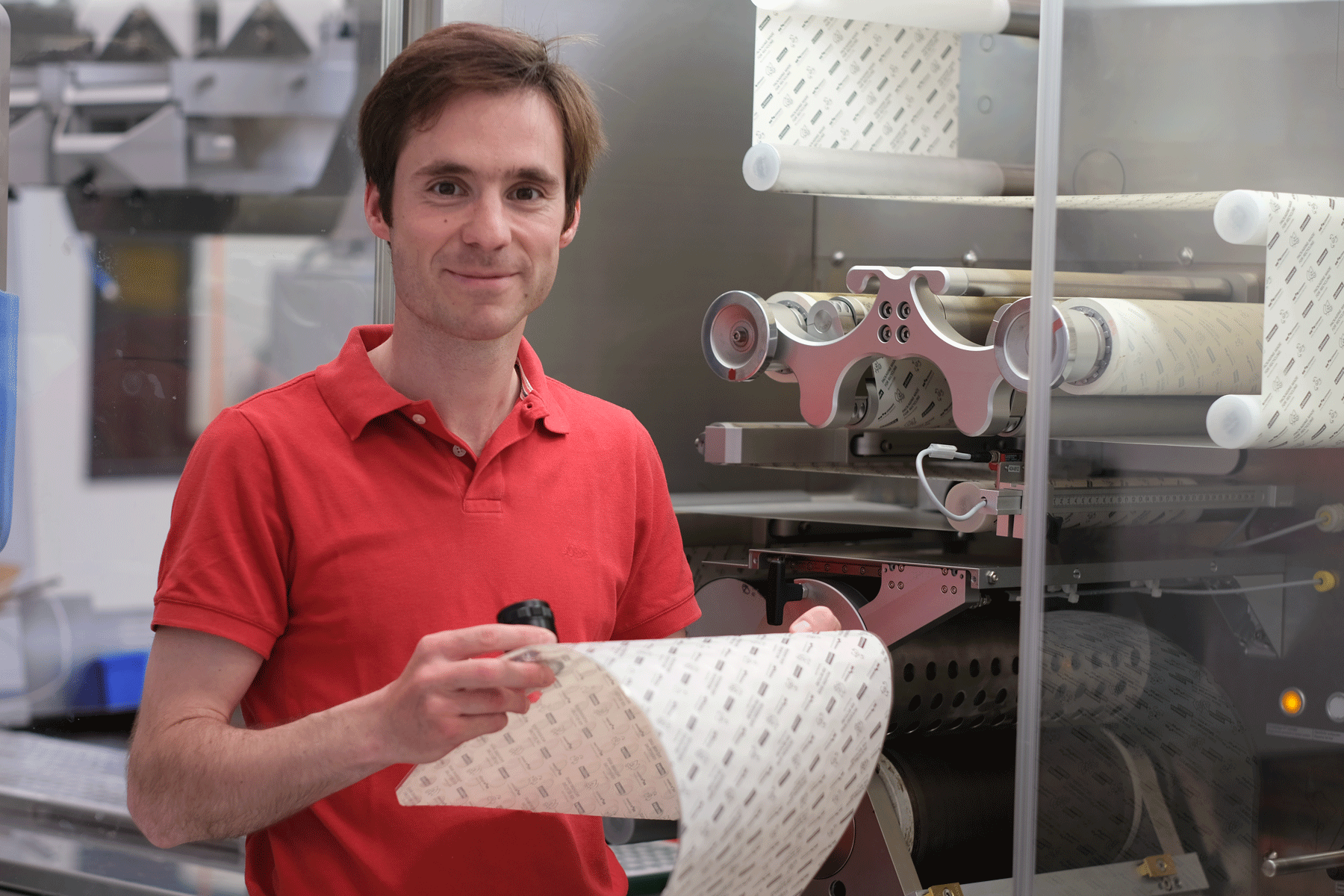
Peter Gellerich and his colleagues often break new scientific ground with their experiments.

In addition to the tests on the machine, knowledge transfer is an important task for the process engineers.
Their aim is to make the process window as large as possible. In other words, the range in which the machine reliably turns out good products. Because the larger the window, the more stable the systems work. “Our process engineers are often working in fields that are very difficult to describe using simulations; it is, in fact, very difficult to calculate in theory how a plastic film will actually behave in reality,” emphasizes Krahl. Building up process knowledge is an essential task of process technology. “To stay with the example of the sealing station,” says Krahl: “Should Uhlmann develop a new sealing station at some point, then the process technology will provide certain requirements for it, which they have determined in their previous tests. These then ensure that a new, robust assembly can be created.”
Our process engineers often work in fields that are very difficult to describe using simulations.
Wolfgang Krahl, Team Leader Process and Simulation
The secret’s in the mix
For Wolfgang Krahl, it’s the wide variety of tasks that make his work so appealing. “There is no routine. Building up knowledge about modeling, frontloading or understanding processes is naturally always very challenging. But that’s exactly what I like about it.” The simulation team, in particular, often has to jump from one topic to the next when urgent jobs arise. Experienced and younger colleagues therefore solve the tasks hand in hand. Everyone benefits. Transparency, openness and reliability are therefore especially important to Krahl in his department. “And a high sense of responsibility,” he adds. “Nobody questions our results afterwards. If we don’t do our job properly, it won’t work in the end. We always have to be aware of that.”
Here, our simulation and process engineers reveal what makes their job so special:
Peter Born, Simulation Engineer, part of the team since September 2020
You act as an internal service provider for the entire Uhlmann Group, what exactly are your tasks in the Simulation team?

We mainly work with designers, but also with programmers. Ideally, we are involved in development projects when it comes to developing new machines or functional assemblies. We support the designers with simulative activities and calculations. Usually, we are asked to address a specific issue, like can my components withstand the load?
So, that means you always consult with the relevant department during a project, right?
Yes, exactly. For example, if we identify a shortcoming in the design, the simulation gives us the opportunity to propose ways to optimize it. We then submit our suggestions to the design department who then check whether they are feasible. This allows us to quickly test multiple variants on the computer. If you always had to use real parts on the machine to do this, it would require a lot more time and effort. At the same time, it is also important for us to find out how well the results from the simulation match the experience gained in the real test. In other words, both in the event that there is a deviation, and in the event that it works exactly as predicted. Sometimes this gets lost in the hectic of the commissioning phase. However, it’s extremely important to get this feedback so that we can constantly improve our models and provide even more accurate statements for future simulations.
What skills does it take to do the job?
In this job you need to work very accurately and responsibly. It also requires good analytical skills, and you need to know how your assembly or machine works and what you’re aiming to achieve. Finally, you have to abstract all this information and break down the functions of the machine into formulas and physical quantities. It’s definitely something you want to enjoy doing. You then have to communicate the results effectively to the development team.
The willingness to try new things is also important. We rarely stick to the same procedure when we do calculations as we are constantly faced with new challenges. Being based here in the development department means that there will always be new functions that we have never implemented before.
Peter Gellerich, process engineer, part of the team since January 2023
What does your job as a process engineer entail?
In process engineering, our job is all about understanding the physical and technical processes that take place in our machines. We try to find out the causes of certain effects and then derive technical requirements from them. This enables us to improve our machines, initiate new developments, resolve customer issues, and support our colleagues in commissioning. Our work is very scientific in nature. Sealing large surfaces is quite a niche topic, and we are breaking new scientific ground, here. We have little to fall back on and have to do a lot of basic research.
Does that mean you spend a lot of time working on the machine and running tests?
That’s right. Only recently, for example, we received an inquiry from a customer who wanted to run a new product with a special film that has a very thick paper layer on the inside. Our job was to work out how we could get the temperature through this cover film from the outside in order to connect both sides. In cases like these we run appropriate tests.
Are the parameters that you determine in your tests subsequently incorporated in the simulation?
Yes, exactly! We are closely interlinked here. Our colleagues in simulation can map the physical relationships and check whether they are basically correct. However, you will always have certain values that cannot be determined precisely in this way. We have to identify these parameters experimentally and the simulation then uses them to enhance its models. During the validation process, we then check whether the results fit. Modeling is always an interplay between simulation and experiment.
What do you particularly like about your job?
I like the fact that it gives me the opportunity to really immerse myself in the details, to work scientifically, and to help colleagues with very specific problems by conducting basic research. This allows us to offer real added value, and it’s just plain fun when you can explain the results to the teams in the other departments and they then say: Now I get it! It’s the same when working with customers. I like the intermediary role we play internally and externally.
What qualities do you definitely need as a process engineer?
You really need to be curious and keen to get to the bottom of things. You shouldn’t be satisfied with quick explanations, but always question them. You also need to work methodically and occasionally stick with something a little longer. Sometimes it takes many attempts, which is why you need perseverance. And you shouldn’t be afraid to embrace complicated methods – they are integral to your work and can be mastered. It also helps if you can approach people and are good at communicating the facts to them. Otherwise, the knowledge won’t be passed on.