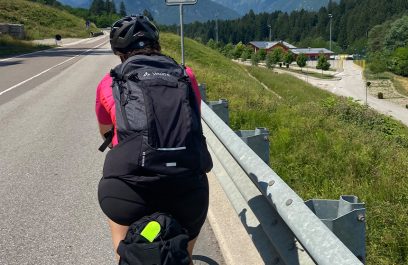
Karlheinz, can you tell us how you discovered your passion for walking barefoot?
Walking barefoot in warm and pleasant weather has always appealed to me. But it wasn’t until I was outside shoveling snow barefoot in winter when it suddenly clicked! What at first seemed like a crazy idea resulted in warm feet and a pleasant tingling sensation in my lower legs. Somehow, I suddenly felt so energized. Something was happening that not only invigorated my feet, but my whole body. That’s what triggered me to take a closer look at barefoot walking.
Are there any other barefoot fans who helped you get started?
There is plenty of information about barefoot running, but for me it was more important to simply try it out for myself and constantly improve. Training to become a natural running coach at the Barefoot Academy Düsseldorf, a visit to the “foot guru” Casten Stark and other workshops provided useful input. I have made good progress, but there is still a lot to discover.

Do you always walk barefoot?
Not all surfaces are suitable for walking barefoot, but you can also wear barefoot shoes, also known as ‘minimal’ shoes. I have since replaced all my shoes with barefoot shoes, which you can now get for work, leisure, or sports. Barefoot shoes have a rubber sole that is only about five millimeters thick, and no raised heel area. And they also provide ample space, especially for your toes.
Why is that beneficial?
As humans evolved their feet developed into an ingenious structure for running and walking. The benefits of this structure, which consists of countless bones, joints, muscles, tendons, and ligaments, are no longer fully utilized by wearing shoes. Yet feet are actually the best shoes. The wrong footwear can damage our feet over time. It can lead to bunions (hallux valgus), flat feet, splayfeet, or kinked feet. The wrong walking technique also often causes problems in the knee and hip joints, extending right up to the spine. Walking barefoot and foot mobilization exercises help to maintain or restore the natural structure. This also applies to a lesser extent to walking in barefoot shoes. I am happy to see that more and more people are using barefoot shoes. However, care should be taken to adapt the walking technique to the shoes.
Karlheinz Kösling, age 59,
Design Engineer Uhlmann Pac-Systeme
- Barefoot walker since: 2014
- Favorite surface to walk on: grass or moss, still slightly damp from the morning dew.
- Most painful experience: grabbing a pasture fence without shoes on
- Best experience: covering 300 kilometers of the Way of St. James through Switzerland, a third of it barefoot.

So what exactly is important when switching to barefoot walking?
Switching to barefoot walking or walking in barefoot shoes has to be done very carefully. The fact that they have no raised heel may initially cause pain in the calves and Achilles tendon. It’s important to start with low-impact training, true to the maxim “less is more”. The guidance of a specialist helps prevent many problems during the transition – I know the very person ….
What are the health benefits of walking barefoot?
Walking without shoes or in barefoot shoes on the forefoot or midfoot strengthens your foot muscles, improves coordination, stabilizes your joints, prevents foot misalignment, trains your calves, and promotes an upright posture. This helps to alleviate or even prevent knee, hip, and back pain. Walking on your forefoot straightens the body and activates the calf pump, which transports blood back to the heart. This stimulates your metabolism. But walking without shoes also has positive effects beyond the physical benefits.
It’s important to start with low-impact training, true to the maxim “less is more”.
Karlheinz Kösling
What effects are you referring to?
I am referring to what is termed as the grounding or ‘earthing’ effect. Stress, environmental pollutants or poor nutrition cause inflammation in our body, resulting in the build-up of excess positive charge, so-called free radicals. As soon as we touch the ground with our bare feet, free negative electrons flow from the earth into our body – exactly where they are most urgently needed to release tension. This restores the balance of positive and negative charges in the body. Direct contact with the earth or swimming in a quarry pond helps us stay (or become) healthy.
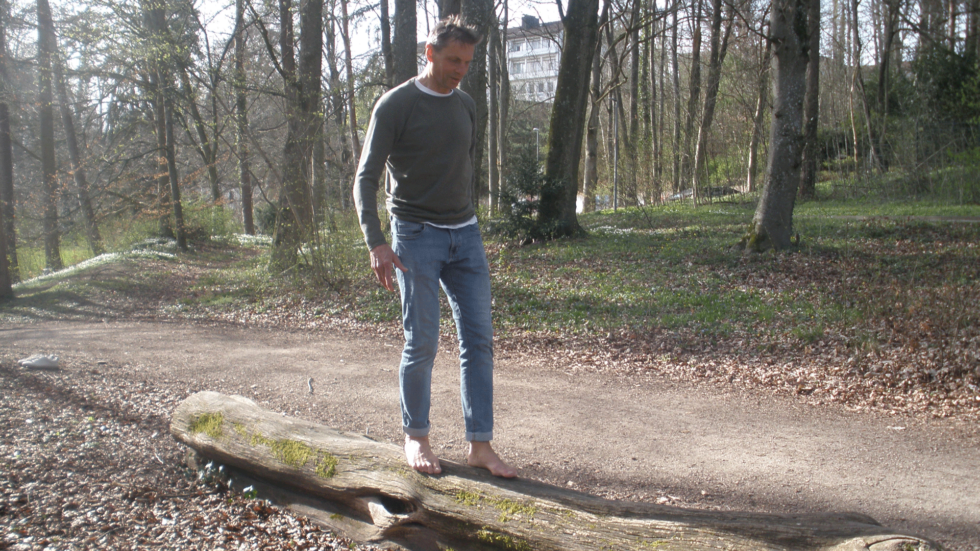
Barefoot balancing gives your muscles and tendons a real workout.
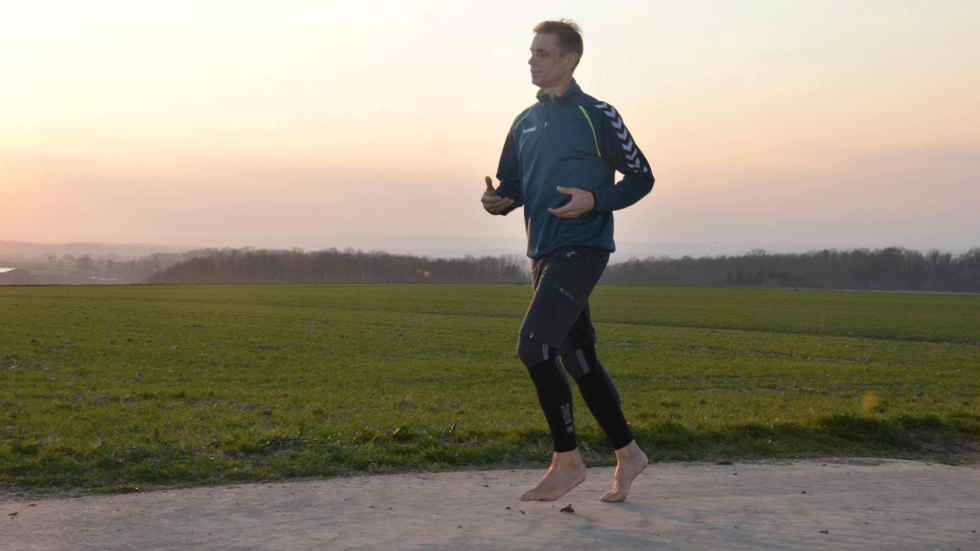
The right technique is crucial when walking barefoot.

Karlheinz Kösling meets up with other barefoot fans once a week in Laupheim.
How high is the risk of injury when walking barefoot?
Walking barefoot thickens the fat pads (subcutaneous fatty tissue) in your feet. Although this makes them less sensitive, it naturally does not protect against all injuries. It is therefore advisable to always carry an emergency pack with you on longer tours. Even in cold temperatures, you should never overdo it – five minutes is often enough. Diabetics or patients suffering from arthrosis, or people who take blood thinners, should only walk barefoot after consulting their doctor.
But what about ankle sprains?
The fact that you can easily twist your ankle in barefoot shoes, especially when hiking in the mountains, is not one of the risks. If you take a wrong step and the stretching stimulus exceeds a certain level, your muscles, tendons, and ligaments will react at lightning speed and compensate. I’ve tried this out myself. In the Allgäu Alps, I traversed the Nagelfluhkette mountain range in barefoot shoes and didn’t encounter any such problems. The grip on uneven terrain is perfect, as the barefoot shoe adapts to the terrain and, unlike the stiff sole of a climbing boot, doesn’t just touch the ground at certain points.
Having direct bodily contact with the earth helps you stay healthy.
Karlheinz Kösling
Do you always walk alone – or sometimes also with others?
At present I am running a barefoot course in Laupheim, which takes place outdoors – both in summer and winter. It comprises a complete package of barefoot walking, foot mobilization, flexibility, and coordination exercises, and ends with a spot of Kneipp water treading in a stream. I think it’s important that people find their own approach to barefoot walking and don’t simply follow my instructions – after all, we are all individuals.
I’d like to see more people taking an interest in barefoot walking. Investing in your health doesn’t have to cost a lot, and it also makes you feel good. A small barefoot path on the company premises, which can be used during breaks to recharge your batteries, would also be a sustainable approach to promoting employee health.
If you’d like to have a go yourself at barefoot walking, please contact Karlheinz directly: koesling.k@uhlmann.de