Marc, you are responsible on our bid team for special machinery. And your hobby is anything but ordinary. So how did you get into extreme mountaineering?
I’ve been climbing mountains for over 20 years now. I love nature and the feeling of freedom you experience in the mountains. It all started with easy tours in the Allgäu region and in Austria. That’s when I realized that I simply enjoy being in the mountains and that they do me good – they’re like a home from home. At some point, the peaks started getting higher, the tours longer and more difficult, and finally the destinations more international. I’m fascinated by how altitude affects you. Once you’ve passed the 5,000-meter mark, interesting things start happening to your body and mind. It’s exciting and very thrilling, especially in combination with your athletic performance. And then there are the risks involved in mountaineering, which of course have a certain appeal about them too…….
Which mountains has your passion driven you to climb so far?
The Zugspitze in Germany and the Grossglockner in Austria were the first high mountains I climbed many years ago. I gradually went on to climb numerous prominent Alpine massifs, including the highest, which is Mont Blanc in the Western Alps in France. My passion eventually led me to my first 6,000-meter summit, the Stok Kangri in India. Later, I climbed the highest mountain on the American continent, Aconcagua in Argentina, and the highest peak in North Africa (Jebel Toubkal, Morocco), and then the Lenin Peak in Kyrgyzstan.
As befits any ambitious mountaineer like me, at some point I started to dream of conquering an 8,000-meter summit.
Marc Grün
Two years ago, I added the first 7,000-meter summit to my list: the Himlung Himal in Nepal. And through these weeks-long expeditions, I realized I could cope with the adverse conditions and the thin air. So, as befits any ambitious mountaineer like me, at some point I started to dream of conquering an 8,000-meter summit. And so last year, I traveled to Nepal again, home to Manaslu, the eighth highest mountain in the world.
How do you find out whether you are good at extreme mountaineering?
ZWell, at first, you’re just a normal climber, but at some point, you might become a skilled climber. And then, if you want to aim higher, you push yourself to more extreme levels without any guarantee that you’ll get it right first time. I made a few mistakes on my first expedition that cost me the summit, but I still gained a lot of experience and know-how. In other words, you become more skilled and accomplished with every tour, but nobody tells you that. But you should only ever climb high mountains if you have quickly learned to correctly assess the risks and, if in doubt, turn back without having reached the summit.
How did you prepare for the ascent of Manaslu?
To get physically fit for the climb, I often just went to the Allgäu or Austria. Typical training involved running up the mountain from morning to evening and then taking the cable car back down again, wearing weight cuffs on my feet and a heavy backpack to simulate the conditions I would encounter during the expedition as closely as possible. That added up to 4,500 meters in altitude – sometimes in constant rain, although that certainly helped my mental preparation. When, shortly before the start of my expedition, I was able to climb the Zugspitze up and back down again in just a few hours instead of the original two-day tour, my body showed me that it was ready to go.
I prepared myself mentally with breathing exercises, meditation, and yoga. On an 8,000-meter climb, unexpected things can happen, and you must assume that you may encounter things you’d rather not see. You have to be mentally prepared for precisely these situations, so that you remain calm and don’t lose your cool if the worst comes to the worst. Finally, of course, an expedition like this has to be planned and organized. The costs were staggering, due in part to the special equipment required, and so securing sponsorships from interested companies was vital.
How did the expedition to Manaslu go?
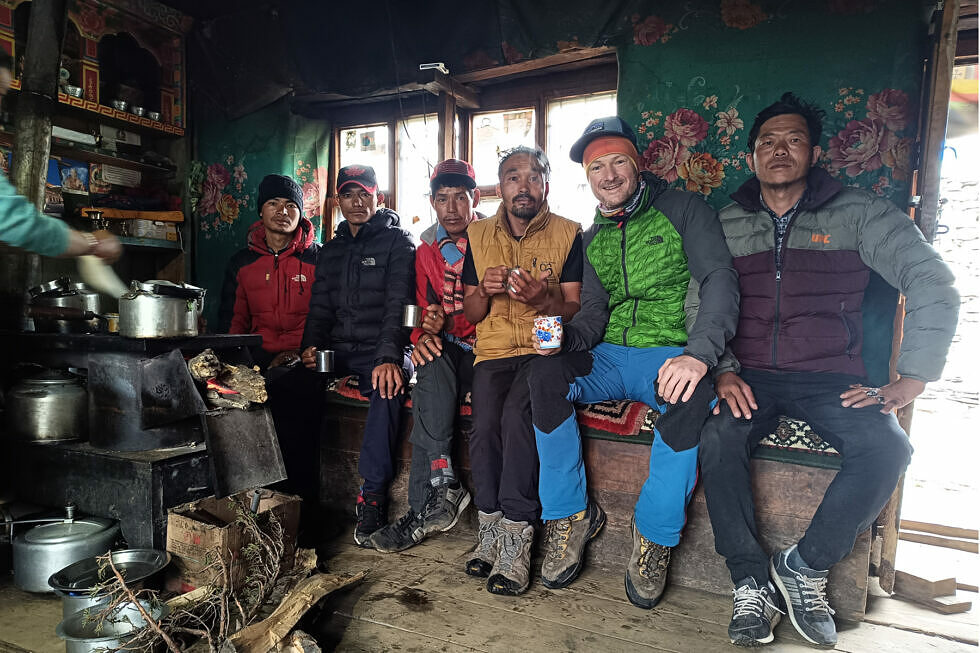
After my arrival in Kathmandu, the capital of Nepal, and making final preparations, we set off by bus to the edge of the Himalayas. We then drove into the mountains for a day in jeeps until the “road” ended. From there, we started trekking toward the Manaslus base camp. We spent nine days passing through gorgeous scenery, traversing forests, gorges, valleys and passes. The night was spent in small villages, mostly with local families, until we finally arrived at the Manaslus base camp at around 4,800 meters. This is where we stayed to prepare ourselves for the ascent.
A human body can only survive in the death zone for any length of time.
Marc Grün
After resting for two days, we began the acclimatization and supply tours to high camp 1 at 5,800 m, high camp 2 at 6,300 m, and high camp 3 at 6,800 m. We deliberately avoided a potential high camp 4 at approx. 7,500 m because it would have involved a huge effort to set up camp there and carry all the material up. The so-called “death zone” also begins at 7,500 m. Above this altitude, it’s no longer possible for a human body to survive for any length of time. We therefore decided to tackle the summit later from high camp 3. After about two weeks, the high camp chain was set up and we were sufficiently acclimatized to attempt the summit. After another rest period of several days at base camp, we were off!
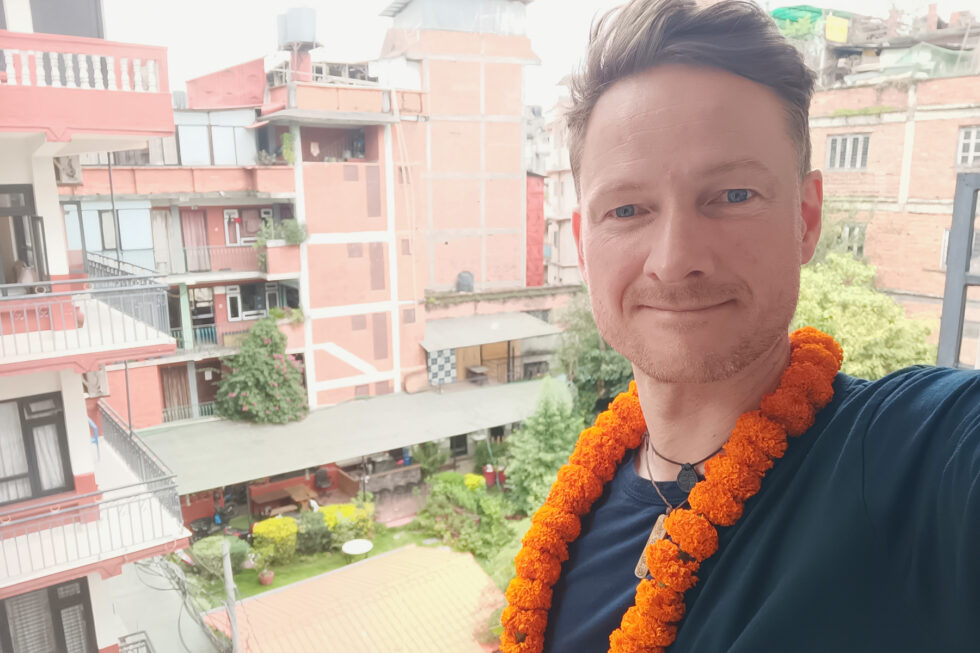
The expedition started in Nepal's capital Kathmandu, where Marc Grün was traditionally greeted with a chain of flowers.
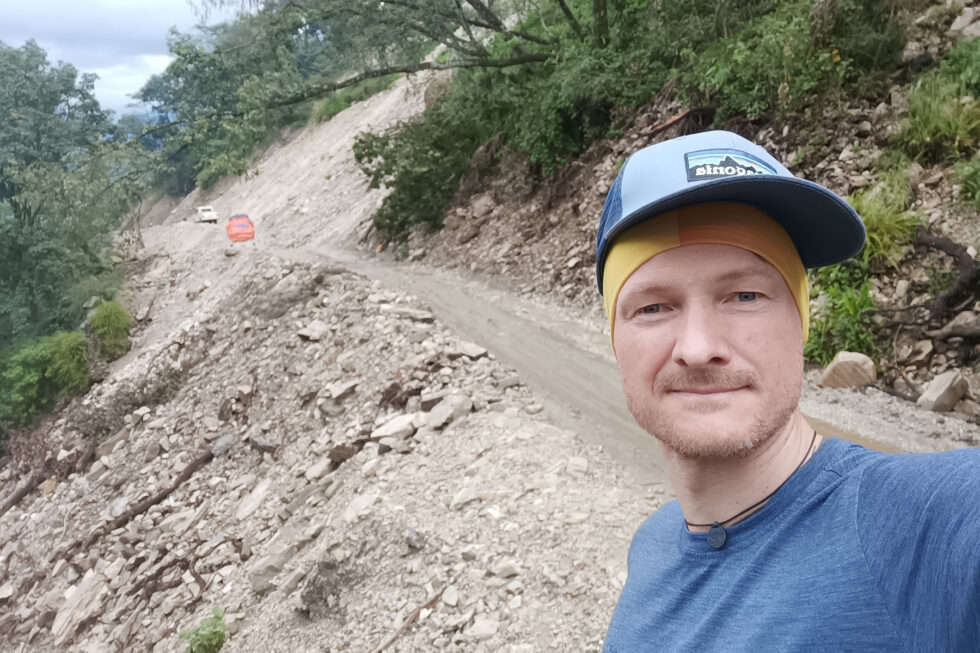
We finally headed into the mountains in an off-road vehicle.

The first week consisted of relaxed trekking towards the base camp of Manaslu.
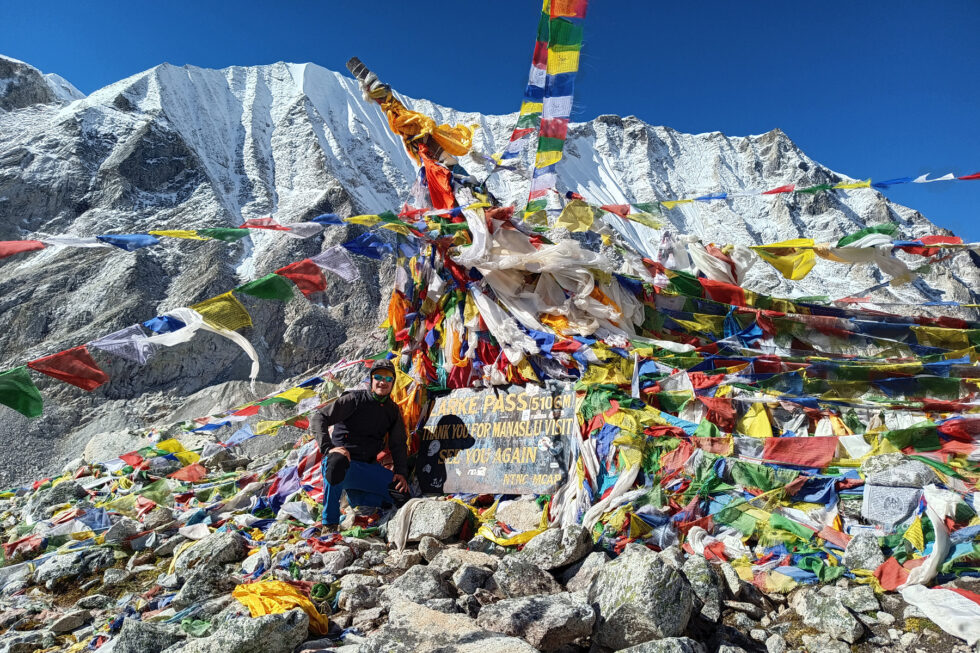
The first highlight of the expedition was the crossing of the Larke Pass at 5,106 metres.
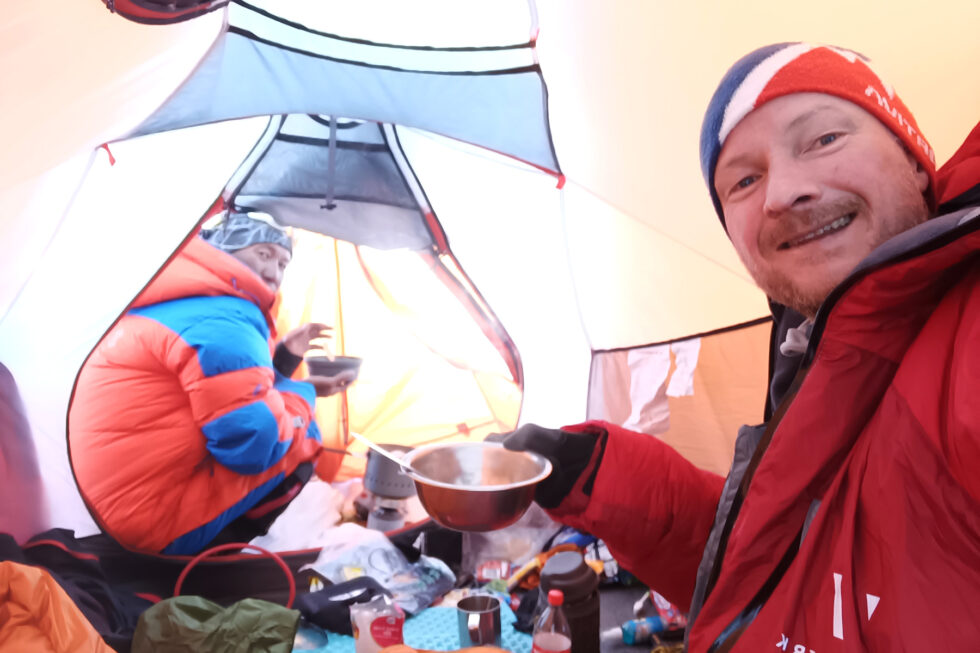
Marc Grün fortifies himself with his climbing Sherpa at high camp 3. Preparing food is not so easy at 6,800 metres!
Towards the summit … Have you reached it?
The conditions on Manaslu were very difficult last year. In the previous months, the glacier had developed quite a few steep slopes that had to be negotiated. Some of these were 80-90° steep, and some were overhanging. Climbing at such an altitude is very demanding and exhausting. We then climbed up the mountain – moving from one camp to the next of a series of high camps that had previously been established.
We arrived at high camp 3 in the late morning of the third day where we rested for a few hours before starting the summit push at 6pm in the evening. The weather was critical due to the cold and a storm – and it was here that we first encountered some serious problems. My climbing Sherpa’s oxygen regulator was defective and had frozen. He therefore had to climb without additional oxygen, which logically caused him obvious problems at this altitude. He was getting slower and weaker, and I often had to wait a long time for him.
We were in the middle of the death zone and making slow progress. His strength was dwindling and he was shattered at just short of 8,000 meters. He couldn’t climb any further and was very weak. His life was in acute danger, so I decided to abandon the summit and try to get him down safely somehow. We couldn’t expect any help as there were no other climbers nearby. We then struggled back down to high camp 3, which took us a total of 17 hours of non-stop climbing and spent a very uncomfortable and stormy night there at 6,800 meters.
So what happened next?
The next day we made our way back down to base camp where we arrived safely after a few hours. Due to the onset of winter and with the logistics chain no longer in place, it was clear that there would be no second summit attempt. After another night’s rest, we started trekking back to civilization from the base camp, which was very strenuous due to the past grueling weeks plus four days of constant rain. After two more days riding in jeeps, we arrived back in Kathmandu – exhausted but nonetheless happy. A hot shower, clean and dry clothes, and a cold beer ……. pure bliss!
How do your family and friends feel about your – not exactly harmless – hobby?
My family and closest friends, in particular, know just how passionate I am about mountains, and that I simply feel good there and at home. I also occasionally go on tours in the mountains with my friends – not to cover any specific altitude or distance, but simply to have fun and spend time together. Nonetheless, my family do, naturally, worry when my next big tour is up. And, of course, they are more than happy and relieved every time I arrive home safe and sound after weeks of radio silence.
You were denied the chance to reach the Manaslu summit. How do you deal with success and failure?
I always see a mountain climb and an expedition as a complete package. For me, it’s not just about reaching the summit. It’s everything that goes with it, like the journey itself, trekking to the mountain, getting to know new people and cultures, experiencing new things; to me, they’re all just as much a part of it. For this reason alone, the first ten days of the Manaslu expedition –before we even started climbing the mountain – were a worthwhile experience. The summit is important to me, but not everything and – certainly not at any price.
Does extreme mountaineering also benefit you in terms of your work?
Yes, absolutely! Every mountain tour changes me. For me, the mountains are like a school for life. They teach me things like positive confrontation and perseverance. Or the confidence that if I invest enough energy and strength in a project, I can achieve anything I put my mind to, even in a critical situation. I think my supervisors also sense that I have developed certain qualities through mountaineering that help me move forward and that also benefit my daily work. For example, I can pull off complex projects – despite all the challenges involved. I have also learned to prioritize. What is important right here and now, and what is maybe less urgent? What do I need to focus on at this very moment? It’s all very helpful in everyday business life. And that’s something the mountains teach you too.
You use your vacations for your mountain tours. So how do you still find time to relax?
For me, being in the mountains is sheer relaxation. It doesn’t need to be a weeks-long expedition; I also really enjoy going on simple tours alone or with friends, like in the Alps. I can’t just sit around at home, there’s always something I have to do. After the Manaslu expedition, I was physically and mentally exhausted for a long time – it was the stress after the stress, so to speak. I find that relaxation exercises and yoga help. In today’s hectic world with busy schedules, the trick is to make the most of the short time available to recover.
Does Uhlmann support you in any way?
I would really like to compliment Uhlmann as an employer. I could hardly expect them to shout ‘hurrah’ when I announced that I would be away for several weeks to tackle an 8000-meter peak in the distant Himalayas. But they always responded with enthusiasm and supported me wherever they could. That’s not something you should take for granted and I am very grateful to them for that.

What’s next on your agenda? Is there already another mountain out there beckoning you?
There are, actually, a few smaller mountains that have been calling me since my return from Nepal. As far as all the really high mountains in the world are concerned, I already sensed during my descent from Manaslu that my mission was probably not quite over yet. But an expedition like this depends on numerous factors that have to fall into place. I’m not getting any younger, and you really have to think carefully about whether you want to put yourself through it all again. But there are definitely a few ideas I already have in mind …