When Werner Schick begins working at Uhlmann in 1986, there is not one department in the company responsible for information technology (IT). “At that time, all we had to support the design department was a team of three and a single computer to share,” he recalls.
And that’s all it took. In the mid-1980s, digitalization is only just starting to take its first baby steps. “If somebody else was using the computer, I would write down the programming code – that I would subsequently use to create a drawing – on a piece of paper and type it in later. At Uhlmann, this was how CAD, or computer aided design, started” says Schick.
Today, thirty-six years later, our Group IT has as over 65 employees – not counting trainees, students and freelancers. Together, they handle a broad range of tasks across the entire group. “No wonder,” says Nicolas Mundbrod, Head of Group IT: “As Uhlmann made huge advances, so did digitalization: Uhlmann has meanwhile evolved into a corporate group with over 2,600 employees, and digitalization has meant that virtually all our company processes are now infused – both in breadth and depth – with information technology.”
Virtually all our company processes are now infused – both in breadth and depth – with information technology.
Nicolas Mundbrod, Director Corporate IT
This change is also reflected in Werner Schick’s daily work routine: In the past, if someone approached him with a problem, he would jot it down in a notebook. Once the problem was solved, he would check it off. “It was pure paper chaos,” says Schick.
It all began with CAD
Schick joins Uhlmann as a mechanical engineering student. Initially, the “native of Laupheim,” as he puts it, stays with the company for four-and-a-half years and writes calculation programs to solve mechanical problems. “They were still pretty basic back then, but they helped,” he says. A “first-aid” service that was also sought after by other companies: In 1991, Schick moves to Liebherr in Ehingen where his work includes developing a program designed to simulate the use of a mobile crane, like finding the right spot for such heavy equipment.
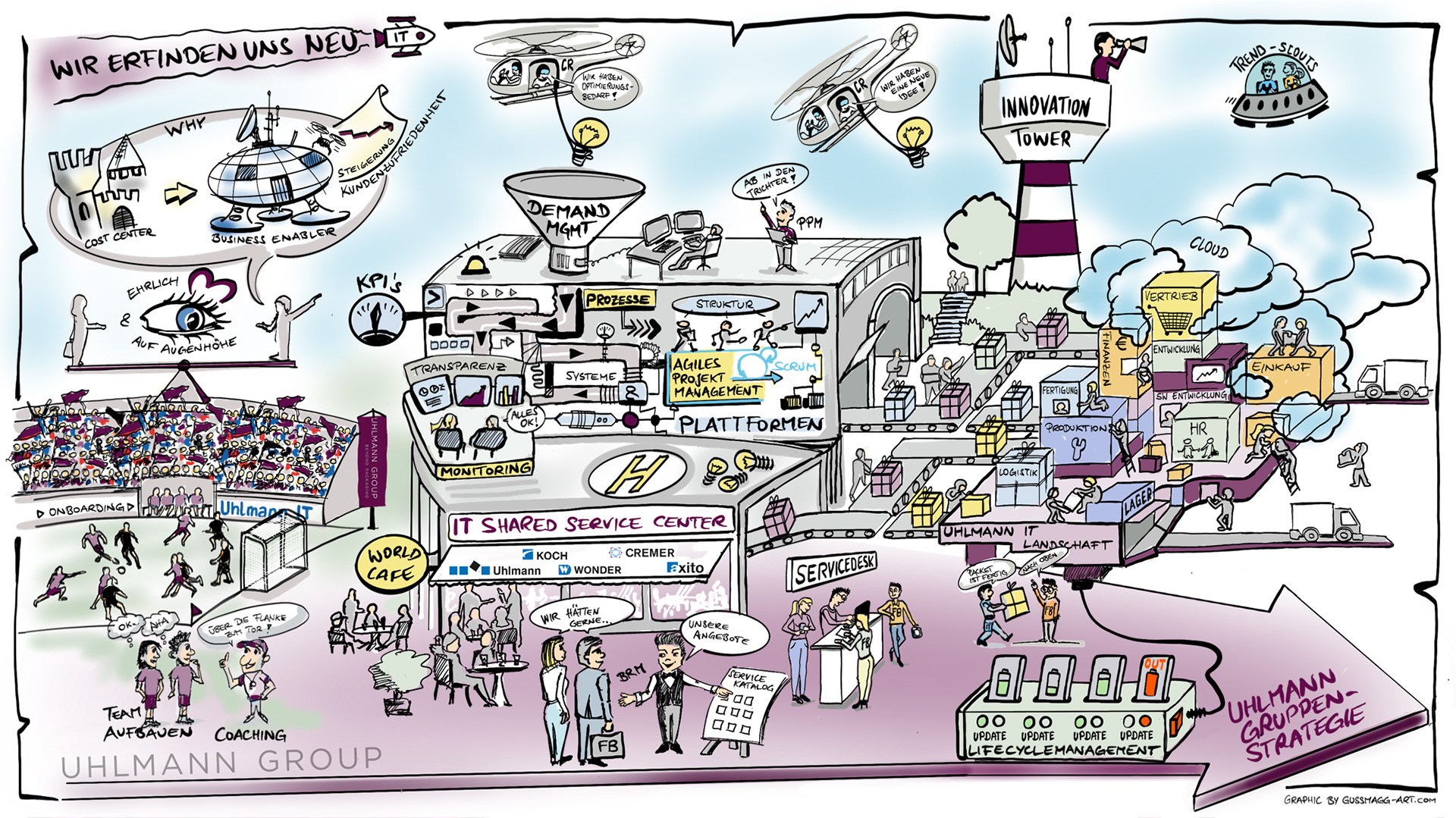
Click on the . signs to learn more. NB: In recent times, the area of IT security and data protection has gained enormously in importance; it may be underrepresented in the big picture, but not so in the real world of Uhlmann.
Meanwhile, IT is making rapid inroads at Uhlmann: computer-aided design is steadily increasing, SAP is being introduced – and Werner Schick’s phone keeps ringing: “In 2000, they asked me if I wanted to come back. At that time, Uhlmann had upgraded from the SAP R/2 version of the ERP-System to SAP R/3, and the team was strengthened accordingly.” For Schick, this was the perfect job, because a “tech scout,” as he calls himself, is interested in any new developments. “Sitting around is just not my thing” says the now 61-year-old.
It’s just as well that Uhlmann is a pioneer in SAP as a reference customer at the time. What Schick likes about this ERP system is that it can be used throughout the entire company: “It’s a platform for all areas, you achieve excellent synergy effects with it, and there is no media disruption when different departments work together”.
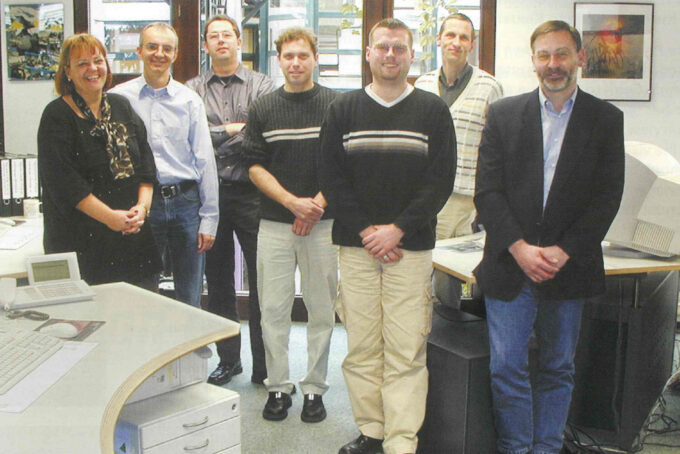
In the May 2001 issue of pactuell, Uhlmann IT still looked somewhat different ... (from left to right): Marion Fiesel, Klaus Kramer, Heinz Groner, Martin Heim, Michael Grötzinger, Roland Schick, Gerhard Rapp ...
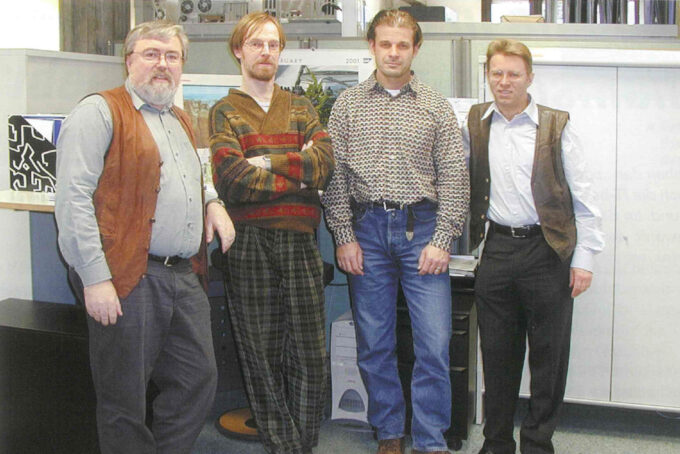
... Peter Wahlenmayer, Gebhard Klinger, Werner Schick, Heinz Schörle ...
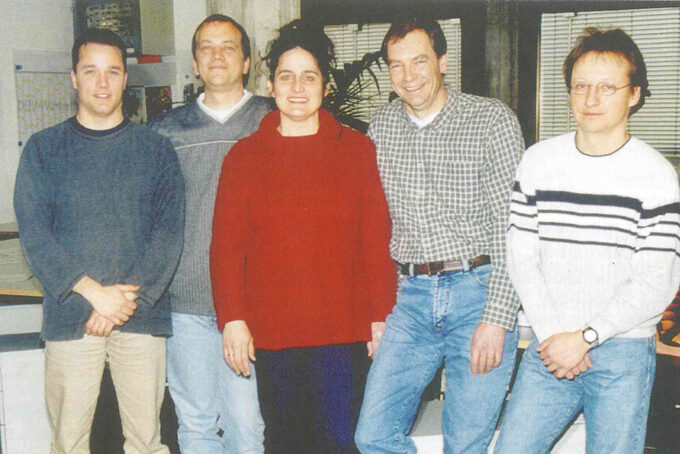
... Christof Ruch, Markus Adler, Gabriele Miller, Albrecht Janz and Thomas Frank
Initially, Schick continues to focus on CAD, because, he says: “Without design, you can’t sell anything as a mechanical engineer. To do that, you have to draw something, manufacture it, and store it. And this is all controlled and recorded with ERP.” But the next technological innovation was not long in coming: the SAP Business Warehouse, or SAP BW for short. In the early 2000s, Werner Schick teaches himself how to use this Business-Intelligence tool: Since then, the self-taught expert has been making sure that the data coming in from all corners of the company can also be used by evaluating and visualizing it. “A pie chart says more than the bare numbers,” says Schick.
Continuous skills development
As the Uhlmann Group expands, so do the myriad tasks of IT – including those of Werner Schick. About three years ago, the SAP Analytics Cloud (SAC) was added. This makes it possible to visualize the most important key performance figures from the entire Group and make them comparable – even on mobile devices.
A pie chart says more than the bare numbers.
Werner Schick, Application Consultant
At the time Schick also takes on a job in the Corporate Finance & Controlling department of the holding company, with whom he has close ties on account of his expertise in SAP BW. “That’s when it became clear that things get moving when you’ve got IT on board,” says Schick, who also trained Jacqueline Sárosi, a colleague from the department, to become a Key User in SAC. Together with her, Schick also trained to become a SCRUM Master and, ever since then, has been a fan of this agile way of working.
It has given way to a ticket that the requester creates in the IT service desk and that is processed on the basis of IT Service Managements (ITSM) (see infobox). Schick thinks it’s better: “Nothing slips between the cracks anymore and everything is clearly documented.” He is simply someone who loves progress. And now he’s facing the next change: The active phase of his partial retirement has just begun, so more time for mountain biking and his dog is within reach. However, he is still taking the upcoming big step in IT with him and will contribute all his experience to the company when it switches to the next SAP version S/4.
What actually happens with my request?
From problem …
Employees of the Uhlmann Group who need support with IT issues, or wish to secure an IT service (e.g., a new cell phone) or initiate changes to systems can call the IT Service Desk during service hours or submit their request via the IT Service Desk using a browser on the Internet.
… to ticket …
A ticket is created based on the request. IT support staff then provide direct support and analyze any additional tickets received to categorize or assign those that were not automatically sorted. More complex requests are then processed in a structured manner by other IT staff.
… to solution.
Since the beginning of 2020, Group IT has processed more than 45,000 tickets for troubleshooting, IT service inquiries and change requests alone. On average, the IT colleagues receive a rating of 4.8 stars for their service. Incidentally, the IT employees themselves are also satisfied with their jobs: in a survey to gauge their satisfaction with the department, they awarded 4 out of 5 stars.
IT with strategy
In 2019, at the same time that the Uhlmann Group Holding was established, a comprehensive IT strategy was approved by management. It lays the foundation for the transformation of IT itself and the structured digitalization of the company group.
The IT strategy is based on four pillars:
- IT as a business enabler
- Professionalization of IT services
- Agile teams and projects
- Re-alignment of IT governance
In order to professionalize IT services and leverage synergies, a group-wide IT Shared Service Center will be created and form the core of a Group IT entity. The group companies will continue to have their own operational IT departments, and the holding company’s Corporate IT will be the umbrella organization responsible for technical supervision of the operational units. In order to create up-to-date, group-wide processes, the potential of IT Service Managements (ITSM) is being exploited and the new processes are being implemented in stages.
The aim is to ensure that Group IT employees collectively attend to the needs of the employees, i.e., depending on the expertise of the IT staff and independent of their location. For example, many Uhlmann IT employees support colleagues from other Group companies (Axito, Wonder, KOCH). In order to act as a business enabler, Group IT is currently managing more than 100 change projects, IT projects and initiatives that are all running simultaneously. One of the central projects is the changeover to SAP S4/HANA at Uhlmann, Wonder and Axito Germany as of this business year.

