“Every second project fails”, “Ninety percent of all major projects do not run as planned”, “Resource conflicts arise in 75% of all projects”: A brief Google search comes up with these and other negative reports. The reasons frequently mentioned in relation to these are poor communication, inadequate preparation and planning, as well as overoptimistic assumptions.

This does not have to be! We want to do things better at Uhlmann and have set up a Project Management Office (PMO) for change projects for this reason.
Mr. Angele, let us start from the beginning. Since when does the PMO at Uhlmann exist and what triggered its establishment?
The PMO was set up at Uhlmann about two years ago. There were various driving forces behind the establishment of a PMO. First and foremost, business decisions ought to be made on the basis of substantiated and updated data. To enable this, it is important, for instance, to recognize dependencies between projects, apply uniform project management standards, and link the financial details of a project to annual planning.
The progressive growth of our company group in particular, as well as the dynamic development of markets and business opportunities make it necessary to have a central office that keeps an eye on the big picture. It enables us to optimally support the organization at all levels.
A PMO can determine the success of the project landscape.
Stefan Angele
How is the Uhlmann PMO organized structurally?
The PMO is embedded in the Central Function UBE (Strategic Projects and Business Excellence). I head the office and there are four employees who are attached to the PMO in a variety of roles, e.g. as key accounts. They are the direct contacts for the ordering parties and project managers in the different business units and divisions. The PMO is closely intermeshed with the Lean Management Office (LMO) and Consulting, the other two pillars of the unit UBE.

Can you explain a bit more to give us a better idea of the work of the PMO?
Gladly. Put simply, PMO lays the foundation for the professional handling of individual and multiple project management. We standardize methods and processes, coach and advise employees, and increase transparency throughout the entire project portfolio. We put the projects into an overall context and rank them in a portfolio. This also helps to visualize resource conflicts, for example. The PMO is a central sparring partner for project management at Uhlmann.

Which benefits does PMO bring the company?
Imagine a project landscape without PMO. We would see individual project approvals, different methods and templates, and varying reporting systems. In the end, no-one would know what is otherwise going on. We would be unable to recognize dependencies, incapable of setting priorities, and also have major problems with budgeting. The PMO helps to handle projects even more professionally.
It is essential that we build up and pass on centralized know-how, and ensure that all project participants speak the same language. It is about the positive feeling of having projects under control at all times.
In the past, we were often challenged to recognize connections between projects and ensure uniform quality standards in project management. As the central hub between the Executive Board and all project participants, the PMO plays a key role for the organization. It helps us to make qualified decisions on the basis of comprehensive information.
Michael Mrachacz, CSO
What are the key elements of a PMO?
- Processes: Definition of processes, determination of responsibilities and roles, standardization and simplification of project management
- Portfolio management: Ranking of all projects in a general context, linking of the projects with the corporate strategy, prioritization and resource management
- Project controlling: Determination and tracking of project effects (target versus actual)
- Communication: Empowerment of the organization, definition and execution of training for project participants, communication of benefits, announcement of changes
- Tools: Definition and provision of tools for all project participants
Which type of projects play a role for you in the PMO?
We look at so-called change projects. All organizational and all Lean Six Sigma projects are meant here. In the case of organizational projects, the project work usually chiefly focuses on creating something new, such as establishing new organizational structures or introducing new, overarching tools. On the other hand, as far as Lean Six Sigma is concerned, we look at existing processes and try to implement continuous improvement.
Development and customer projects are not currently part of our spectrum because of the widely varying characteristics, but we have also been able to help define processes and standards.
You mentioned the Lean Management Office (LMO). What are the differences between the PMO and the LMO?
Both teams are specialists in project management, support the organization, and train and coach. That is definitely what we have in common. Our activities are closely coordinated, not least through the organizational anchoring of PMO and LMO in UBE. The differences are to be found in closer details. Our ProjectPlus process applies equally to organizational and Lean Six Sigma projects. When it comes to content, however, the differences become visible in the realization phase of projects, e.g., regarding the use of tools and templates. PMO looks more at organizational projects, while our LMO specialists attend to all Lean Six Sigma projects.
In our eyes, it is particularly important that the contracting party and the project manager reach a common understanding at the start of a project.
Stefan Angele
Let me take up one point here. What is ProjectPlus? Please tell us a bit more about that.
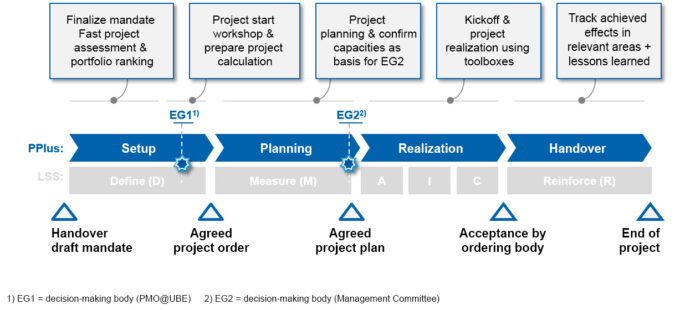
Of course. ProjectPlus is our internal brand name for the project management process at Uhlmann. Its application is binding for all change projects. Various specifications have been determined in the process phases setup, planning, realization, and handover, in order to be able to handle projects even more efficiently and according to common standards. The focus is clearly on the first two project phases.
In our eyes, it is particularly important that the contracting party and the project manager reach a common understanding at the start of a project. This minimizes the risk of having to take countermeasures in subsequent phases. Our process, with its tools and templates, ensures transparency and commitment, and helps all project participants to adopt a structured approach.
That sounds like a lot of effort. Surely than means extra work for the project?
Admittedly, it may appear so at first glance. However, I wish to stress a particularly important aspect at this point. The PMO, the forms to start a project, and the approval process are not ends in themselves. All our activities pursue the clear objective of supporting the organization the best possible way. This covers all project participants and all management levels. By making a bit of extra effort at the beginning, we want to reduce any idling or unplanned expense in the subsequent project phases. Imagine two captains in their ships, planning to reach a harbor.
The first captain is highly motivated, wants to get home quickly, and immediately heads off in one direction. The second captain waits a moment, checks his maps, and confers with his first officer. Only then does he set off. Which ship presumably reaches the harbor first?
How do I start a project?
- Procurement of information through the UBE confluence webpages (e.g., instructions for use)
- Contact the PMO (e.g., the respective key account)
- Clarification of the background and scope of the project
- Completion of defined project documents (e.g., mandate and project assessment)
- Coordination between ordering party and project leader
- Submission of project documents to the relevant decision-making bodies (EG1 and EG2)
Where can our employees find more information on the PMO?
We have created new confluence webpages for UBE. Interested colleagues will find plenty of information related to the PMO, our process, the tools, and upcoming training. Our instructions for use are filed in PDF format on the first page. These cover key information and checklists for organizational and Lean Six Sigma projects in a compact form. Also to be found on our webpages are all relevant contacts. Should anyone have questions or feedback, I encourage colleagues to contact me or my team directly at any time.
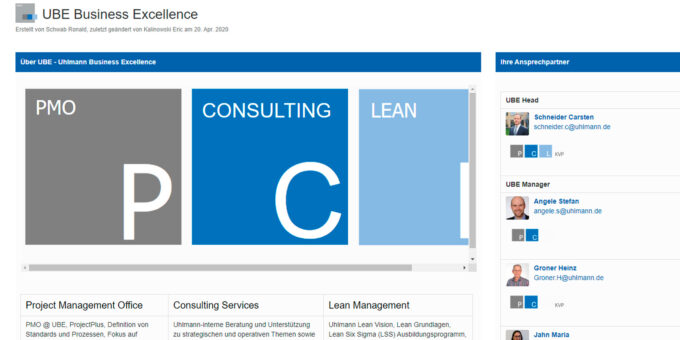
For more information, visit our confluence site.
What future plans do you have for the PMO?
We are very pleased with what we have achieved so far, but what is neither wanted nor permitted is stagnation. My LMO colleagues will agree with me: There are always leverage points for improvement. Important aspects in this business year are, for example, that we further improve our process together with our internal clients, anchor portfolio management more deeply in the organization, and extend our training program. Probably our biggest project is the company-wide introduction of new software for single and multiple project management. We are checking various options, also in conjunction with our project leaders. As you see, we have plenty of plans and our work remains exciting.