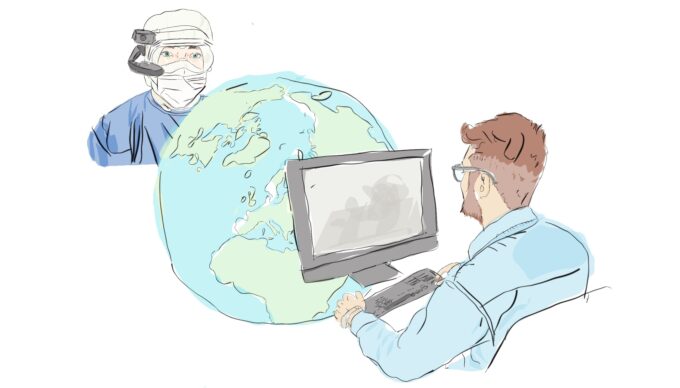
Most people probably associate business travel with “real” people traveling to “real” places on business. Since the onset of the COVID-19 pandemic, traditional business travel has been increasingly replaced by virtual business trips.
The fact is, though, that new technologies often simply cannot replace being physically present on site. That’s why traditional business trips at home or abroad are still “alive and kicking”.
General COVID-19 travel warnings and business travel
Travel and safety warnings for specific countries have been in effect since October 1, 2020. The German Robert Koch Institute (RKI) also provides updates on relevant travel information.
Due to the COVID-19 pandemic, the German Foreign Office continues to warn against non-essential tourist travel to numerous countries. However, some official trips are still necessary and are therefore permitted.
Business travel since the COVID-19 outbreak: colleagues from Uhlmann Pac-Systeme share their stories
Marcus Gehring embarked on the China business trip adventure under corona conditions in October and November 2020
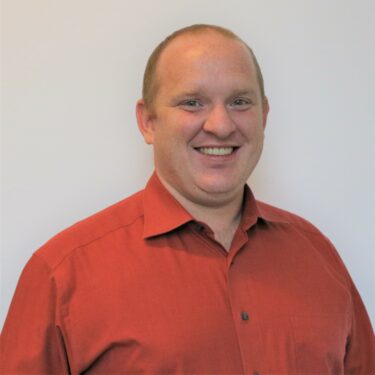
Traveling to China during the COVID-19 pandemic first entails a lot of discussion – and it already starts in Germany where you have to fill out the health QR code form.
In my case, it all worked out, but, to my surprise, the code remained red! Maybe it was because we did the test at the airport test center rather than at Centogene. “You’re barred from entry”, “You’re free to proceed”, “You’re barred from…….”, and then, as soon as the next “You’re free to proceed” appeared, I quickly scanned the ticket and crossed the cordon to board the plane. “STOP! You’re not allowed in” – “Oh yes I am, your colleague said so”, I replied, quickly disappearing up the stairs. And here I was at last, sitting on my plane in Germany waiting to take off for China.
During the flight, you’re checked for fever, but otherwise everything is as per usual, that’s if you don’t count having to wear a mask non-stop for almost 12 hours – unless you need to eat or drink something.
Once you arrive in China, everyone at the airport pretty much speaks fluent English, so communication is not a problem. You have to go through the whole procedure – but that only goes in one direction: So you want to choose a quarantine hotel? Seriously? The next one with a free room is yours!

Then in the hotel, no one spoke English anymore. Fortunately, fellow travelers from Germany helped me fill out another online questionnaire (in Chinese only) and show the QR code to the staff.
Finally, I was inside my room. Time to take a breath of fresh air and remove my mask. Actually, it wasn’t quite as simple as that. All the windows were locked! Just as well I had brought along my multitool and was able to open them. A glance out the window told me that everyone knew about this tool. All the windows were open.

The first meal came: no knock on the door, no phone call, no information at all. All of a sudden, I just found it waiting outside my door. This happened every day and with every meal. Breakfast was served from 7 a.m. or earlier, lunch was served at 10:30 a.m. at the latest, and dinner never arrived after 4 p.m. So you either got a hot brunch or cold lunch.
Full board in this hotel meant: You get food, but if you want something to drink, you have to order it yourself. That’s not easy if the staff don’t speak English and you can’t speak Chinese (Fun Fact: Coke cans were only available in a 48 pack). At some point, thanks to our subsidiary, I got hold of the hotel manager’s phone number and was able to order some bottled water.
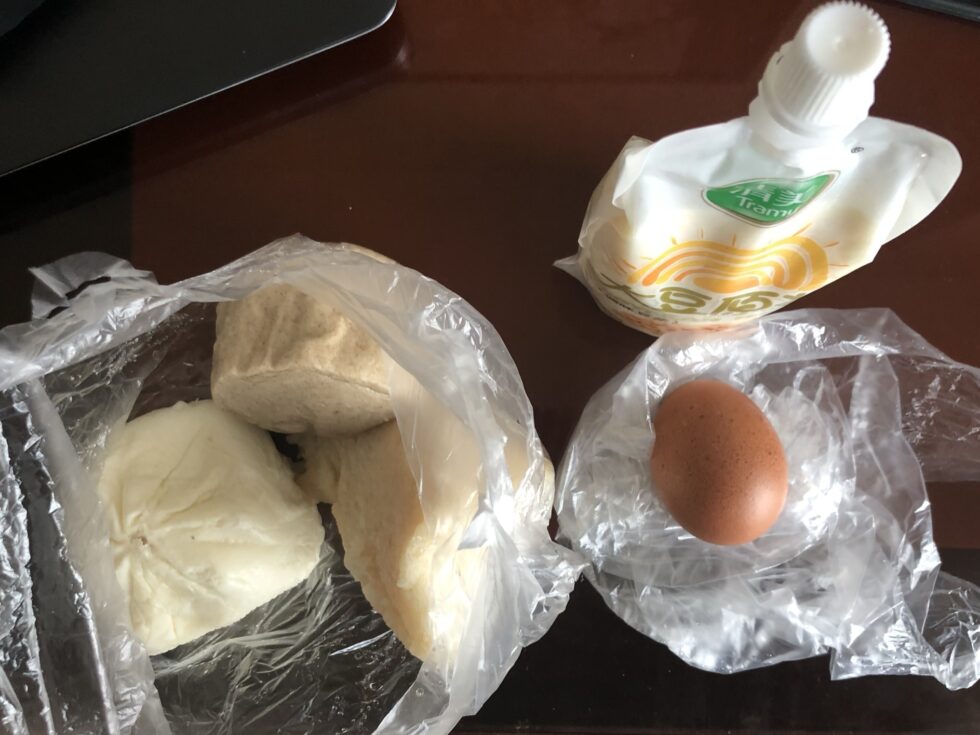
Breakfast in China

Lunch in China
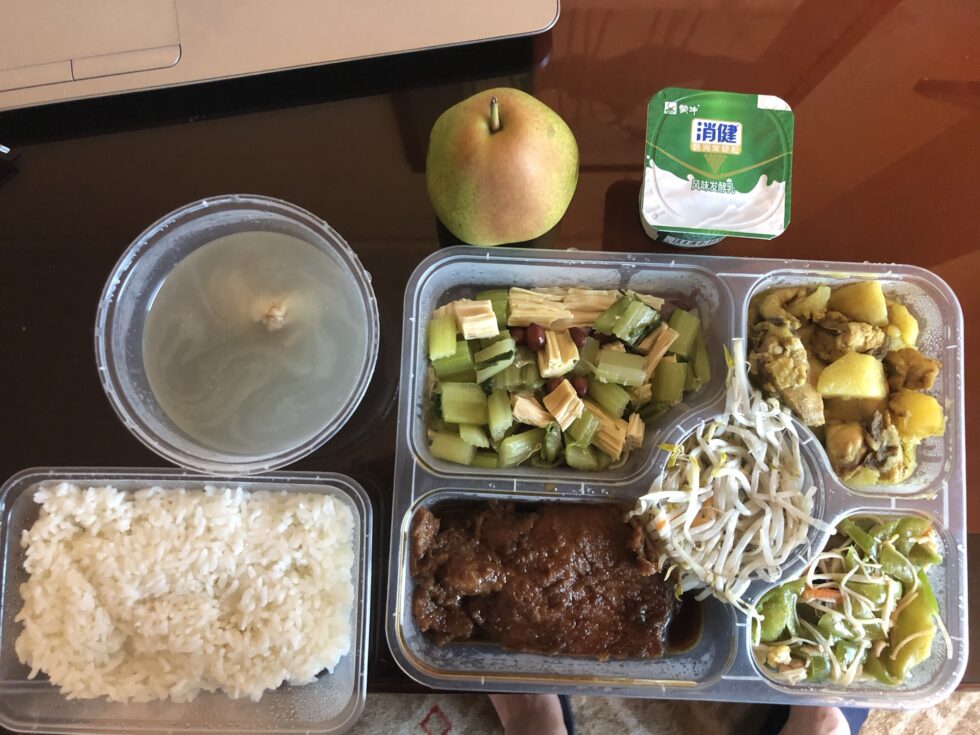
Dinner in China
After 14 days of “detention” (including video surveillance and security personnel throughout the premises), everything was back to normal. With one exception: there was no longer any need to wear a face mask – except in the subway. Freedom at last! I would like to take this opportunity to say a big thank you to our subsidiary for supplying me with different tasting foods and cleaning utensils.
Would I do it again? Sure I would!
And I’ll tell you why. It’s because, even though being holed up in my hotel room was tedious and strenuous, it certainly helped me improve my chopstick skills! Our Shanghai colleagues did their best to provide us with everything we needed. Our customer was aware of our situation and was most accommodating. For example, we were allowed to choose whether we wanted Chinese or “Western” food.
And to all my colleagues out there: I hope that your next trip will be an enjoyable and safe one again!
Kai Kathan organizes trips and makes sure our colleagues can travel safely – even under COVID conditions
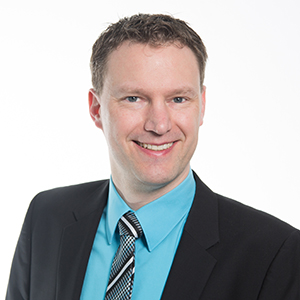
I am responsible for organizing business trips and ensuring travelers’ safety. This so-called Travel Risk Management, which has been in place at Uhlmann since 2019, includes services like the external Travel Risk Manager, an alarm ticker, the travel agency, the travel organization, or the 24/7 helpline. We are charged with ensuring that travelers enjoy maximum safety during their business trips.
In this context we always apply the regulations of the state of Baden-Württemberg or those of the destination. Since these rules can change on a weekly basis, my biggest challenge is to keep up to speed with them, and also to translate them into a language that everyone can understand.
During the first two months of the lockdown, we saw a drop in the number of trips for assembly assignments. From May onwards, we were back to normal. For the year as a whole, the figure was maybe 15% lower than in the previous year.
The number of trips for consulting purposes and business transactions, on the other hand, really fell dramatically, showing a decline of around 90%. Nevertheless, as travel risk managers, we are just as busy as ever, because the job of organizing trips has become much more complex, which means our workload has gotten a whole lot bigger.

Claudia Maier provides travelers with information on every aspect of COVID-19
At Uhlmann I am in charge of everything to do with coronavirus. This involves working closely with the girls from the travel department, and with the external travel risk manager and the Corona task force.
My work includes issuing information to travelers before and after completing their trips, working with external travel risk managers, and managing the hotline number.
This is the gateway for all coronavirus inquiries, like general queries on how to deal with colleagues or infected individuals, arranging appointments for in-house testing which is now available at Uhlmann or external testing, queries about traveling to and from different countries, and about any shortages of masks or self-tests. I also manage our corresponding e-mail address: coronavirus@uhlmann.de.
Our hotline is also the go-to place for employees who have concerns about upcoming trips.
Meanwhile, I also organize the large number of cases that fall under our company’s coronavirus travel policy which I put together and pass on to the HR department.
These are not easy times at the moment and each individual is affected by the pandemic in very different ways, either privately or professionally. But I think we can all be proud of the disciplined approach and caring spirit we share within our Uhlmann community.
Last year, Peter Aubele spent November thru December working on an assembly job in Mexico
Before we set off for Mexico, we received various information, for example, from the external travel risk manager and our internal travel office, including hygiene regulations and on-site quarantine requirements. You obtain a lot of details at relatively short notice. Overall, travel preparations – including the return journey – have become more stressful. The actual trip itself, though, is less arduous: the airport and the plane were virtually empty. On some of these trips, there’s only two of you sitting on the plane with the whole crew looking after you.
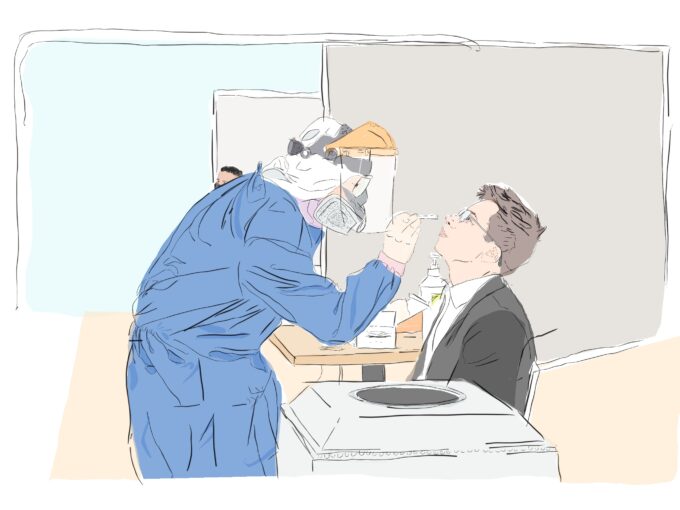
On arriving at our hotel in Mexico, there were a few precautions to observe. First of all, we had to take a COVID test and then immediately go into quarantine for six days. After that, we had to take another test. At least we were allowed to walk around the hotel from time to time. Every time we came back to the hotel, our temperature was taken and a bottle of hand sanitizer provided. Safety precautions were also observed during meals: The breakfast buffet was cancelled, but we were able to order food to our rooms.
In our customer’s plant, we had to dine in a separate room where we were separated by plexiglass walls and had to leave a chair’s space between us. And restrictions did not just apply to meals. During work, apart from wearing face masks, we were also kept strictly isolated from people working on other projects. That felt really weird.
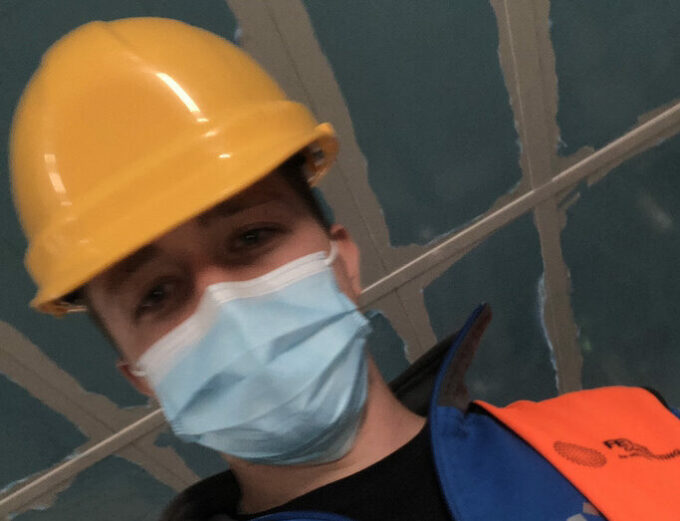
Peter Aubele in conversion and corona protection equipment

Weekend outing: location closed, view still beautiful.
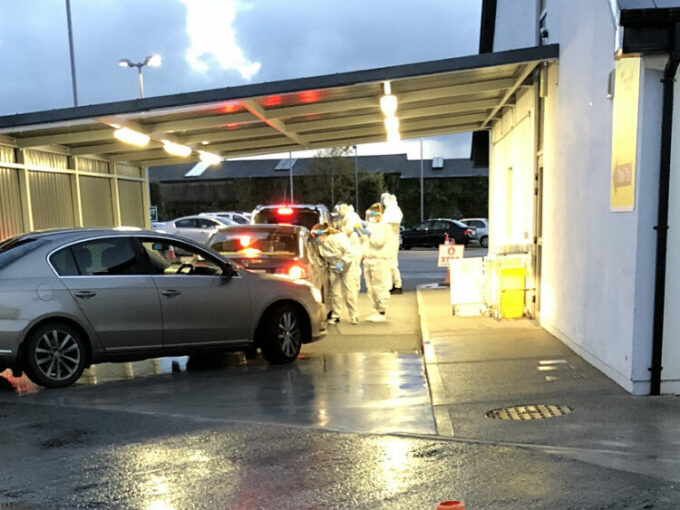
COVID-test in Ireland
Following a coronavirus incident that occurred at the customer’s site, we had to take a COVID test at the doctor’s which fortunately came out negative. Even so, our assembly job was still terminated ahead of time because the other contact persons on site had to self-isolate, and so there was no one around anymore. I, myself, had to take a total of six COVID tests, i.e., prior to departure, on arriving at the hotel, on the last day of the quarantine, on the first day working on site, and another one due to the COVID case at the customer’s plant, and, finally, on returning home to Laupheim.
I’ll be glad when the whole coronavirus crisis is over. It’s not just the extra work before, during or after the trip. You also have very few leisure opportunities to compensate for a long working trip to a foreign country. In Mexico, like in Germany, bars and tourist attractions were closed.
And then there are the restrictions that affect your private life: Even if you don’t have to go into quarantine after your assignment, there’s no guarantee that you’re absolutely virus-free. That’s why I am particularly cautious at home, especially when it comes to my grandmother.

From September to December 2020, Nico Schuch was in Brazil working on a customer assignment
Coronavirus testing has made traveling so much more difficult: To enter Brazil, you need a letter of invitation from the customer, a transfer letter from Uhlmann for ‘special urgency’ cases (pharma), and a negative COVID test.
On arriving in Brazil, I had to take a drive-thru COVID test for 50 euros, which was fairly easy (and getting self-tested was also pretty simple back then). Initially, the test result was positive. I was then tested more frequently until it turned out that it was a false-positive result, because in the final antibody test there were no antibodies in my blood. Then I was faced with the next challenge. For my return flight, I had to get a test done that was no older than 48 hours because it normally takes 72 hours to get the results.
Back in Germany, at the airport in Munich, I was tested again and then, thanks to an agreement with the city of Laupheim, I was able to leave the very next day with my negative result.
What I really found frustrating was having to sit around at home on my own waiting for the test results – that is anything but fun. In the end, though, complaining doesn’t get you anywhere – you just have to move on.
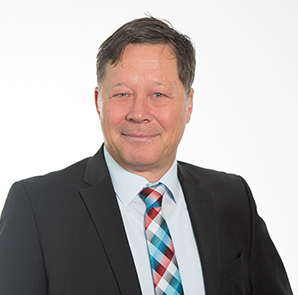
Before the outbreak, Reiner Mann often visited our German customers to conduct consultations, negotiations or business deals
I did not travel at all during the first lockdown phase, nor during the one we currently have. Customers only want to see “travelers” for really important assignments, like for repairs or installations. Sales activities are carried out exclusively via Teams and Zoom meetings, or by phone/email.
In the summer months, when the situation was less critical, I was traveling quite normally. The only thing I had to do was wear a mask and have my temperature checked at the customer’s site.
Nicola Giustizieri has visited several countries since the outbreak of the COVID-19 pandemic
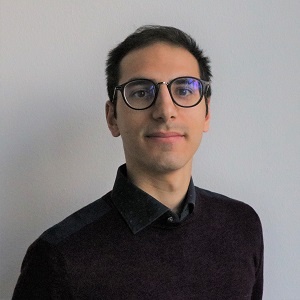
I have always enjoyed traveling. But the virus put a stop to that. My colleagues, though, were still able to travel. And that really is so important because working at our customers’ sites is critical to keeping the healthcare machinery up and running and saving as many lives as possible.
You need a mask, a COVID test, and, after spending a few days in quarantine, it’s time to get started.
Where there is shadow, there is always light. Safety measures, which are already very stringent in our area, have been ramped up to ensure that everyone can continue to work as safely as possible. Highways and airplanes are particularly empty, and travel is decidedly relaxed.
Thanks to the possibilities we have to digitally streamline bureaucratic processes and convert to using smart working methods and online meetings, we’ve clearly moved forward.
The customers we visit are aware of the sacrifices we all make, and even if we can’t have our usual chat over a beer at the bar, we can always be sure of a big THANK YOU for the huge team effort.
In 2019, Adham Elashmawy was in charge of customer service assignments, including jobs in Italy
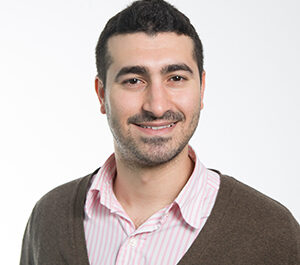
For us, as project managers, customer service trips have always been particularly challenging. First, you have to find the right customer service engineer or technician, then you have to schedule the assignment with everyone involved and organize the trip, be it by plane, car or train. And finally, you have to find hotels in the vicinity, etc. These challenges, just like the number of COVID patients, have increased exponentially.
Thanks to a “Corona Task Force” specifically set up for this purpose, approval must now be obtained from the business unit before, say, a technician can be sent to Milan. Care must then be taken to ensure that this person ideally does not have a partner whose health might be endangered by the trip, etc.
Customers must also now declare whether they can guarantee the safety of our employees and whether they will bear any additional costs incurred as a result of the coronavirus pandemic. All of this has to be put down in writing. The biggest problem, however, is the government rules and regulations, which are constantly changing.
I myself had to cancel a trip to Saudi Arabia just one day before I was scheduled to leave because of the new regulations. These are the daily challenges we project managers face every day. And it’s anything but fun. But our software engineers and electrical and mechanical engineers are extremely open-minded and flexible when it comes to traveling on business – even in these times. And that deserves a very special thanks!
In these coronavirus times, I managed to get to Milan faster than I have ever done before. I did the check-in online and only had hand luggage with me, so I didn’t have to go through another check-in at the airport. The airport was empty and I got through security and arrived at the gate in less than 15 minutes. The plane took off on time and even touched down 20 minutes earlier than planned. From Erbach to Milan in just 4 hours by plane – a new record for me!
The bottom line: business trips are not holiday trips
These interviews and personal reports show that traveling in COVID times has, indeed, changed quite a bit for our colleagues:
- There have been fewer business trips (especially trips for consulting purposes and business transactions).
- Constantly changing regulations, red tape and health risks has made the job of organizing travel more complicated and demands meticulous planning.
- Direct contact with colleagues or business partners during the trip is limited, as are opportunities for personal leisure and entertainment at the weekend or after work.
There is one thing, though, that hasn’t changed: the pretty efficient way our colleagues manage and master their travel routines. Many thanks to all travel planning and support staff at home. And special thanks also to all our flexible and patient “globetrotters” who enjoy traveling on business for Uhlmann and our customers – whether in the past, now, or in the future.
Thank you for traveling!