Sustainability is no longer a “nice-to-have,” but a decisive success factor for companies that want to remain viable in the future. The topic is also deeply rooted in the Uhlmann Group—in our purpose, our vision, and our mission—and forms a central component of our new corporate strategy, GO FOR 30. The goal is to actively shape tomorrow’s success today: through sustainable action, the development of new business areas and technologies, and through partnership-based cooperation.
A successful sustainability strategy is characterized by the fact that it is not viewed in isolation, but is derived from the corporate strategy and is in line with the company’s values. Clear, measurable objectives backed by concrete measures are crucial in this regard. Sustainability goals take into account ecological, social, and economic aspects and actively involve internal and external stakeholders. The aim is to leverage the company’s individual strengths and thereby create transparency and commitment. This is precisely the holistic approach we are pursuing with our new strategy—for us, sustainability is not an isolated project, but a key success factor for long-term growth and innovative strength.

What topics do we consider to be part of sustainability?
Sustainability encompasses much more than just climate protection – today, it is viewed holistically under the term ESG. ESG stands for Environmental, Social, and Governance. Many ESG activities are already being implemented individually in the group companies. The group-wide sustainability strategy will leverage synergies across the group and anchor common goals.
These three dimensions form the foundation for sustainable business practices:
E
Environmental
E – Environmental
This involves the responsible use of natural resources and the protection of our planet. The focus is on issues such as energy and water consumption, emission reduction, and the development of sustainable products and solutions.
S
Social
S – Social
The social aspect encompasses commitment to employees and society. This includes occupational health and safety, diversity and equal opportunities, and fair conditions throughout the entire supply chain.
G
Governance
G – Governance
Governance stands for transparent, compliant, and ethically responsible corporate management. This includes compliance with legal requirements, effective management and control mechanisms, and measures for corruption prevention and business ethics.
The need to strategically embed sustainability stems not only from our own drive, but also from the increasing demands placed on us – by customers, by legal requirements, by competitors and, last but not least, by society and our colleagues. If you want to remain competitive in the long term, you have to take sustainability seriously and implement it consistently.
Overview of the Action Fields and Ambition
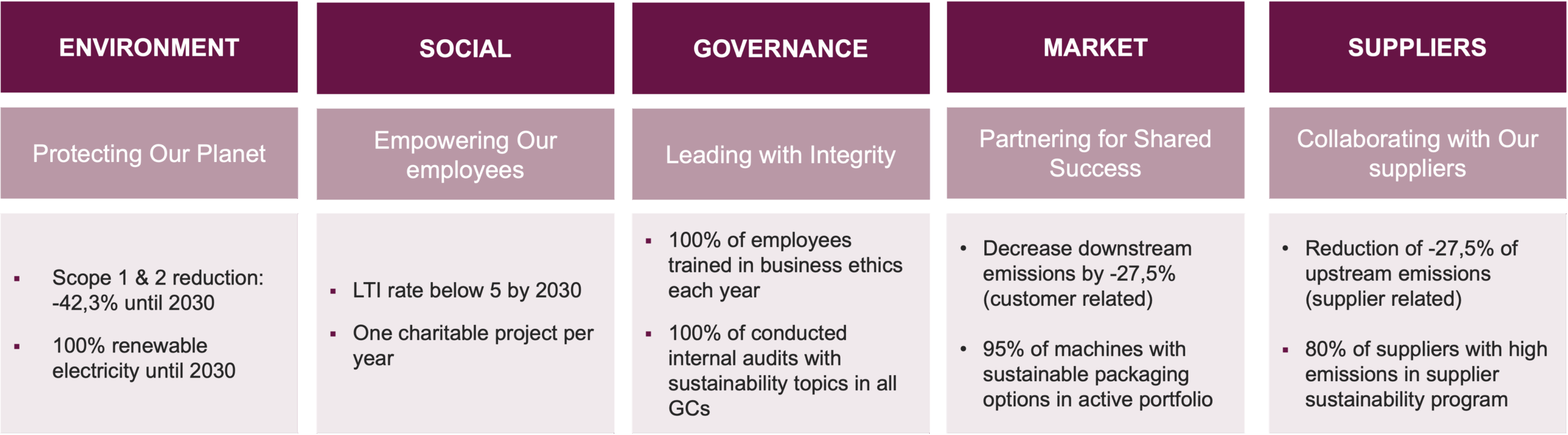
These goals naturally apply not only to individual companies, but to the entire Uhlmann Group. We therefore sat down with colleagues from Uhlmann, KOCH, Cremer, and Wonder to find out what the new sustainability strategy means for these Group companies.
Why is it important for you to embed sustainability in your strategy?
- Uhlmann: Embedding sustainability strategically is essential for us, as our customers’ requirements are constantly increasing—and in some cases are even laid down in contracts. Issues such as climate protection, transparency, goal setting, and reporting, as well as social aspects such as diversity and human rights along the supply chain, play a central role, especially in the pharmaceutical industry. A clear strategy helps us to meet these requirements in a structured, proactive, and credible manner.
- KOCH: Sustainability is a central component of KOCH’s corporate strategy. We bear responsibility for our planet and its population—and we actively fulfill this responsibility. With our portfolio of solutions, which includes sustainable packaging, we make a significant contribution to the sustainable transformation of our customers. The focus is always on customer benefit: our solutions are not only sustainable, but also economically viable and future-proof. Initiatives to develop sustainable packaging solutions (e.g., packaging regulations) show how we proactively translate regulatory requirements into innovations and strategically anchor sustainability.
- Cremer: Legal requirements in the EU, particularly within the framework of the Green Deal and the climate targets for 2050, make a sustainable approach essential. In the Netherlands, sustainability has long been part of social consciousness—our society expects us to take responsibility. A clear strategy makes us more attractive as an employer and strengthens our position in the market.
- Wonder: In China, sustainability is particularly important in view of the close cooperation with our global partners, who expect high standards. At the same time, we are seeing a steady growth in environmental awareness in China, both among authorities and in society. Strategically anchoring sustainability helps us to respond to these developments and secure our international competitiveness.
Are there any planned projects with a focus on sustainability?
- Uhlmann: Uhlmann is focusing specifically on sustainable projects in various areas. The focus is on construction measures such as roof renovation and conversion to LED lighting in building C1, as well as the introduction of an energy management system in accordance with DIN ISO 50.001. The purchasing department is working on greater transparency in the supply chain and is aiming for BME certification as a “Sustainable Procurement Organization” in silver. HR is also contributing to sustainability – with paperless travel expense reports, fully digital contract signing, and the exclusive use of hybrid and electric vehicles in accordance with the company car policy.
- KOCH: In addition to developing sustainable machine solutions and packaging concepts for our customers, we are also pursuing the goal of making our own production more sustainable and reducing emissions. We will be implementing several projects to this end. We are currently converting all building lighting to LED technology and will complete this project by the end of the year. In combination with the planned photovoltaic system in the coming years, we are making an important contribution to reducing emissions. The further development of sustainable packaging concepts for internal and external goods transport also contributes to this goal. Another aspect of our sustainability strategy is health and well-being in the workplace. Our employees are actively involved in the further development and implementation of appropriate measures.
- Cremer: We already use 100% renewable electricity for our operations. In addition, we are investing in local, on-site energy systems to reduce our dependence on the public power grid. At the same time, we are gradually converting our vehicle fleet to fully electric vehicles – including our own charging stations. These measures help us to become more energy-independent and resilient and to better achieve our long-term sustainability goals.
- Wonder: Across the group, we have launched a supplier and customer program to systematically reduce CO₂ emissions along the entire value chain, both upstream and downstream. At the same time, Wonder has begun to purchase green electricity certificates, starting in the 2024/25 fiscal year. In addition, Wonder is actively promoting its sustainability strategy and deepening it within its supplier and customer networks. This includes accelerating recycling initiatives – such as the reuse of machine wooden boxes and other materials – as well as internal improvements in manufacturing and assembly efficiency. These measures are supported by our own KINGSOFT software and are based on the first-time-right philosophy, which increases product quality, minimizes scrap and rework, and ultimately contributes to a significant reduction in CO₂ emissions.
What opportunities or challenges do you see in implementing the strategy?
- Uhlmann: In the Customers field of action, we see a great opportunity in equipping all of our active machines with Product Carbon Footprint (PCF) data. This means that we record how many emissions are generated during the manufacture, use, and disposal of a product—in other words, throughout its entire life cycle. This enables us to record the emissions of our products much more accurately – and, based on this, to develop more targeted reduction measures. We see the main challenge here in the systematic collection and availability of the necessary data throughout the entire product life cycle.
- KOCH: Implementing this strategy requires investment, a willingness to change, and clear priorities—but at the same time, it offers us the opportunity to credibly fulfill our responsibility and ensure long-term success. With our portfolio of solutions, we enable the sustainable transformation of our customers. In doing so, we create real customer value, position ourselves as a future-oriented partner, and strengthen our market position.
- Cremer: The strategy gives us the opportunity to develop innovative solutions and tap into new business areas – especially in the field of sustainable packaging technologies. Sustainability thus becomes a driver of innovation. The challenge lies in reconciling these developments with existing processes and structures.
- Wonder: We are delighted to be further expanding our collaboration with our suppliers. Only by working together can we achieve our ambitious emission reduction targets. The sustainability strategy provides the right basis for this by enabling us to include more suppliers in our supplier program and thus initiate partnership-based solutions.
What unites all Group companies is the conviction that anchoring sustainability in our GO FOR 30 corporate strategy is of great importance. The sustainability strategies complement our previous sustainability efforts in a meaningful way and create a clear framework for achieving our goals in a structured and effective manner. Goldfuß is also supporting us in our sustainability goals and has successfully completed its first EcoVadis assessment this year.
With commitment, cooperation, and our goals in mind, we will achieve this together in the Uhlmann Group.