Of course, not everyone must complete their training with an award or a special commendation – although we are pleased when this is the case. This year, no less than four apprentices were honored: Julian Härle, Linda Ostertag, Raphael Demuth, and Luca Stehle. Each of them had individual experiences, but one thing they all found good was the quality of training at Uhlmann. Why is it so high? We pursued this question.
Learn to be independent
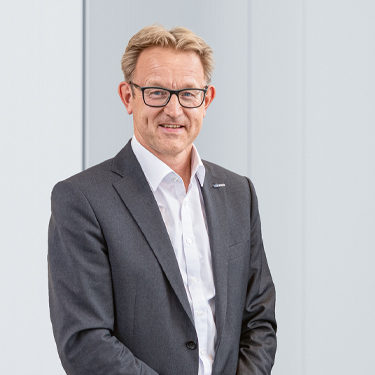
Alfred Merz is now training manager at Uhlmann. He himself was an Uhlmann apprentice in the 1970s and later trained to become an instructor. He contributes the strength of Uhlmann training to a variety of factors, the first being independence. “I see myself more as a training mentor. I don’t stand there and tell the apprentices to do something this or that way. They must first work out things for themselves. Naturally, I am there to answer their questions”, he explains. This is a new experience for many, especially for those straight out of school. In the end, however, it helps them to make progress.
The second factor is responsibility, which is delegated to apprentices at an early stage. After the first six months of their training, they start producing parts for regular orders. “What the apprentices produce is later fitted in our machines”, says Merz. “It is important that the young people learn to be one hundred percent behind their work.”
The third factor is good communication – between the instructors, and between the instructors and apprentices. The trainees complete an anonymized survey once a year to assess how satisfied they are with their training. “We are able to improve our performance on this basis”, states Alfred Merz. In turn, the training personnel meet every three to four weeks to discuss matters.
What can be learnt at Uhlmann?
Apprenticeships at Uhlmann include mechatronics engineer, electronics technician, industrial mechanic and more.
How many apprentices does Uhlmann train?
The number of apprentices at Uhlmann is constant at around 100 young persons.
How is training structured?
During their first 18 months, apprentices generally learn practical and technical basics, e.g., in metalworking and CNC programming, in the training workshop. They subsequently sit the first part of their final examination and rotate through the various departments. Depending on the trade, they complete the apprenticeship after three to four years with the second part of the final examination.
Who is commended?
Apprentices with more than 95 points in the final exam (marks from the first part also count) receive an award.
Uhlmann has a good reputation
One outcome of the interplay of these three factors is that our apprentices are frequently commended and training at Uhlmann enjoys a good reputation. “We hear this at vocational training fairs or from teachers in the schools”, explains Merz. Awards or commendations are often received at the end of an apprenticeship. Good exam preparation significantly contributes to the good results regularly attained by our apprentices.
“Several weeks before the final examination in January, we spend time in the company going through exams tasks from previous years”, says Matthias Hötzinger, who supervises the apprentices together with the instructors Alfred Merz and Michael Sälzle. “However, to reach the standard of our top trainees, it is necessary to sit down at home and do the proverbial homework.”
Enjoyment is a must
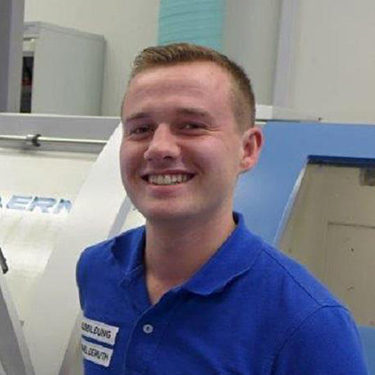
One factor not to be neglected among all this learning is enjoyment. “I enjoyed my training in industrial mechanics from the start”, says Raphael Demuth. “The technology behind a CNC machine, for example, fascinates me.”

Linda Ostertag liked being able to get a taste of widely differing areas during her apprenticeship. “It is very diverse”, she says. She is studying mechanical engineering based on the “Ulm Model”, a combination of theory and practice with a shortened training period.

Luca Stehle, qualified industrial mechanic, particularly valued the good practical orientation. “I want to work as a design engineer at a later stage. It is very useful to learn in an apprenticeship how parts are made in the first place.”

Julian Härle, electronics technician, was so motivated that even a six-month break due to illness did not hinder him. “I caught up on most things at home, but was always able to ask in the company if something was not clear”, he explains.
Open to change and improvement
The instructors are also committed to their work. “Aged over 60, I come into daily contact with 16- or 17-year-old youngsters. That keeps me fit and I enjoy it”, says training manager Merz. “I can teach the young people things, but personally gain from them as well. Learning never ceases, which is good.”
What our commended apprentices are now doing:
Having completed his apprenticeship at the end of January 2019, Luca Stehle is presently attending dual education studies in mechanical engineering. He later wants to work as a design engineer.
Linda Ostertag is likewise completing a bachelor’s degree in mechanical engineering. She commutes between Laupheim and Ulm.
After a three-year apprenticeship as industrial mechanic, Julian Härle has gone on to train as an electronics technician. This is motivated by his wish to become a final assembler and the perspective of job assignments in many places.
Raphael Demuth is working in production at Uhlmann and first wants to take things as they come workwise.