Colouring book for children on fire protection
The district fire brigade association promotes the topic “fire safety education” also for kindergarten children and therefore publishes a children’s colouring book already in its second edition.
The book explains the topic with great pictures. In addition, it is supplemented with a memory game, so the little ones can playfully test what they remember.
Uhlmann was happy to support this children’s book and memory game with a donation. It will now be made available to local kindergartens. There are also some copies for staff members. Anyone who would like a book can pick it up at the reception in Laupheim – while stocks last.
Ralf Fischer, Project Manager UP, Squad Leader in the Achstetten Fire Department


Why did you join the fire department?
For me, joining the volunteer fire department at that time was a way to meet people and play an active role in my new community. Besides, helping people is always worthwhile.
What kind of training did you undergo in the fire department?
I started out as a squad member and then became a squad leader, which includes using radiotelephony. I’m also a smoke diver and an engine operator, which means I get to drive the fire truck. This gives me special right-of-way privileges so I can drive through red lights.
How often are you on the job?
About every two months I have to drop everything at work and head out. Recently, I spent a total of ten hours attending a house fire. On average, the calls last between one and two hours.
On one job we were able to find missing persons alive in a cornfield with the help of drones and thermal imaging cameras.
And the worst?
A suicide.
Martin Renz, Project Manager UC, Group Leader in the Laupheim Fire Department
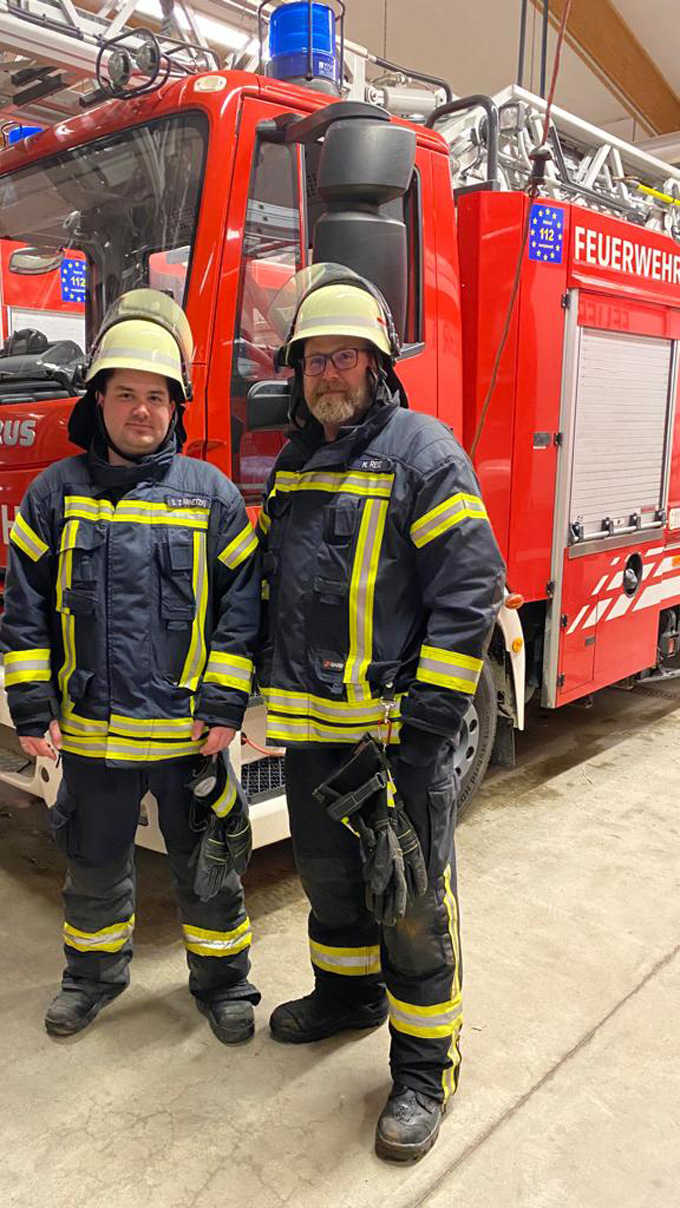
Why did you join the fire department and what keeps you going?
I’ve been involved since I was a teenager. And my motivation is definitely the fantastic camaraderie we have.
Have you ever had an assignment involving Uhlmann?
Yes, actually several. Once a transformer burned, and then there was also a flooding incident. And once we had a false alarm. There was also one special call-out we had where we had to hose down one of our own exhibition tents all day because it was so hot.
How many call-outs does the Laupheim Fire Department have each year?
About 250. There are over 100 of us but only some are called out depending on the alert level. I have about one call-out a week, standard drills every 14 days, and training or e-learning every now and then.
What kind of qualities does a firefighter need to have?
That would definitely be physical and mental fitness, and a criminal record is a no-go.
What was your most satisfying experience?
For me, the best part of being in the fire department is what happens besides the actual missions – especially the camaraderie and singing the firefighters’ song together. That outweighs everything and makes traumatic experiences, like emergencies involving children, easier to bear.
How long was your longest mission?
That was a fire at Lako, the Laupheim coconut weaving mill, which is in Uhlmann’s neighborhood. It lasted twelve hours, but we had to deal with hot spots that kept popping up the whole week.
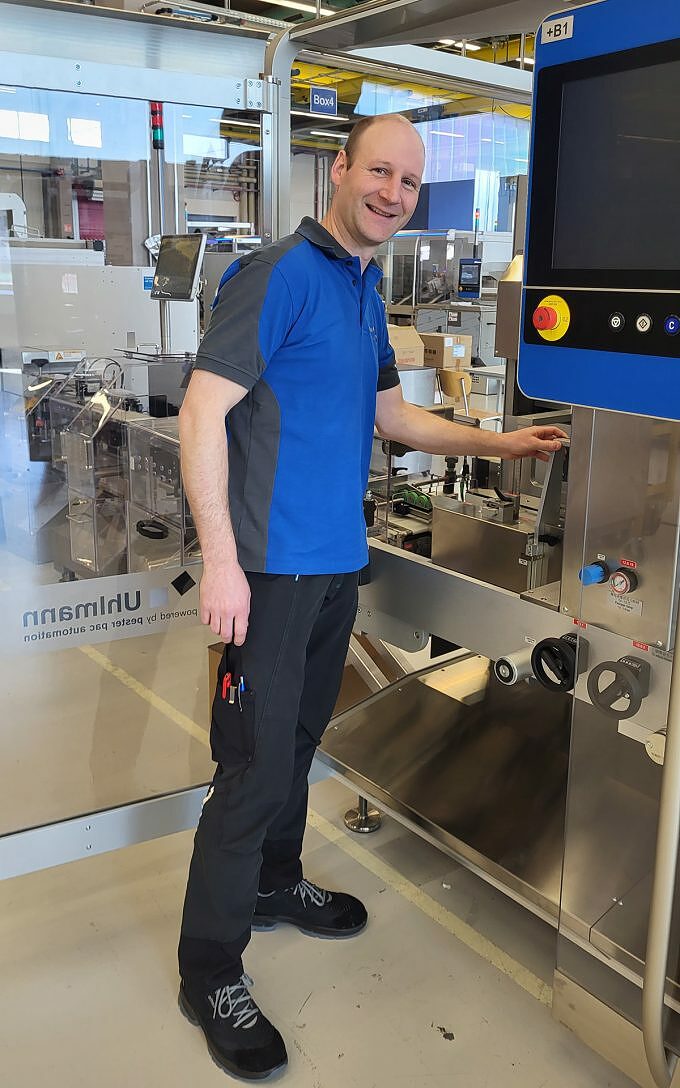
Andreas Russ, Team Leader Assembly Synchronisation, Commander of the Schönebürg Fire Department

Why did you join the fire department?
I started as a career changer in 2006. The camaraderie appealed to me and still keeps me here to this day. And, of course, I have always had a thing about helping others – and that’s an absolute must-have!
How do your colleagues feel about it when you get called out on a mission?
They’re fine with it. Three of the staff on my team at Uhlmann are also firefighters. But as they work for other fire departments, our assignments don’t clash.
How many call-outs do you get each year?
I’d guess between 15 and 20, although most of them have not been during working hours.
What was the nature of these missions?
All kinds of things, really: from rescuing a cat or a parrot stuck in a tree or a dog trapped in a manhole, clearing away downed trees on forest roads, to traffic accidents, fires and also floods, where I was also on duty for about twelve hours. The worst thing for me were the traffic accidents. That makes team spirit – and not just within our own fire department – and joint activities all the more important. In summer we meet every 14 days, and every four weeks in winter.
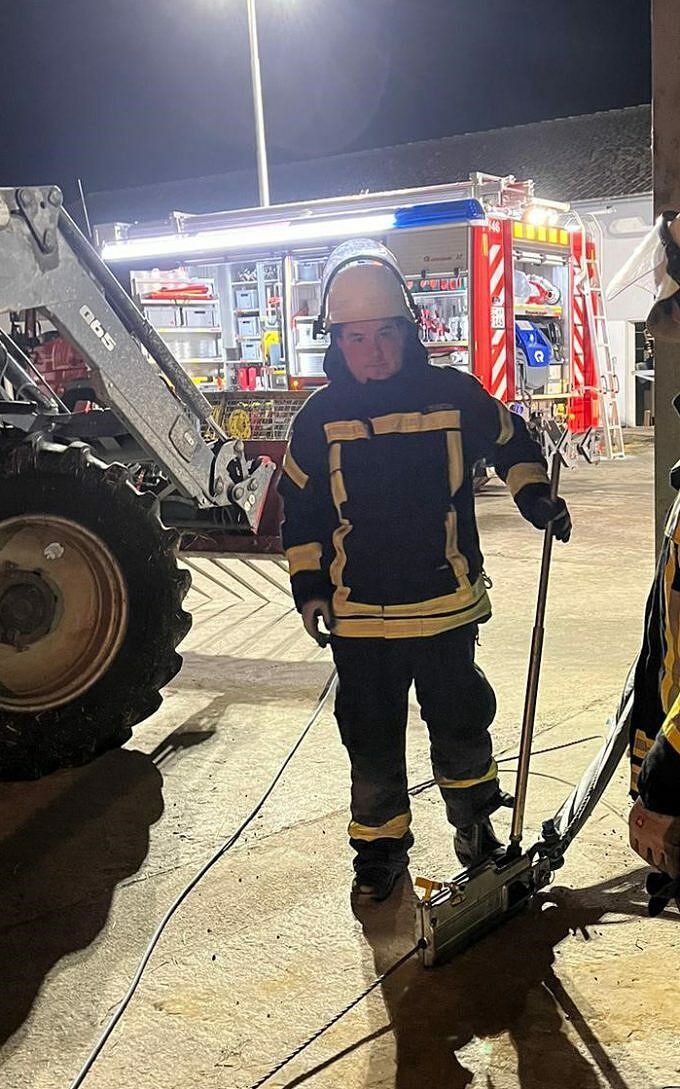
Dominic Ziarnetzki, Production Specialist AXITO, Group Leader in the Laupheim Fire Department

Why did you join the fire department and what’s your job there?
My father was already a firefighter, so I had contact with the fire department from an early age. When we moved to Laupheim, my neighbor took me to the junior firefighter group where I completed my basic training and secured the junior fire badge. At the age of 18, I underwent squad training and, two years later, squad leader training. In 2017, I went on to take the group leader course at the State Firefighting Academy in Bruchsal. I’m also a district instructor for engine operators.
Have you ever had an assignment involving Uhlmann?
Just the once, when an electrical appliance caught fire in the assembly building.
What was your worst and best experience in the fire departement?
The camaraderie and the team spirit are great. We meet every 14 days for drills to stay fit on all the vehicles and equipment, but we also go on outings together and have a lot of fun. The worst experience was a serious car accident with several fatalities.
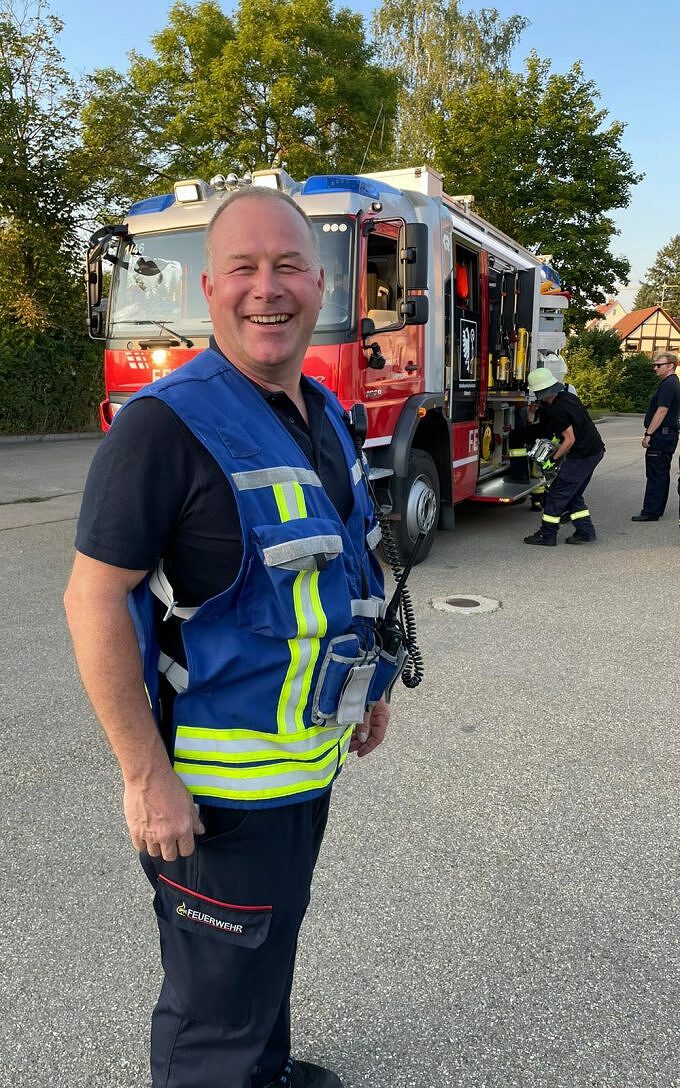
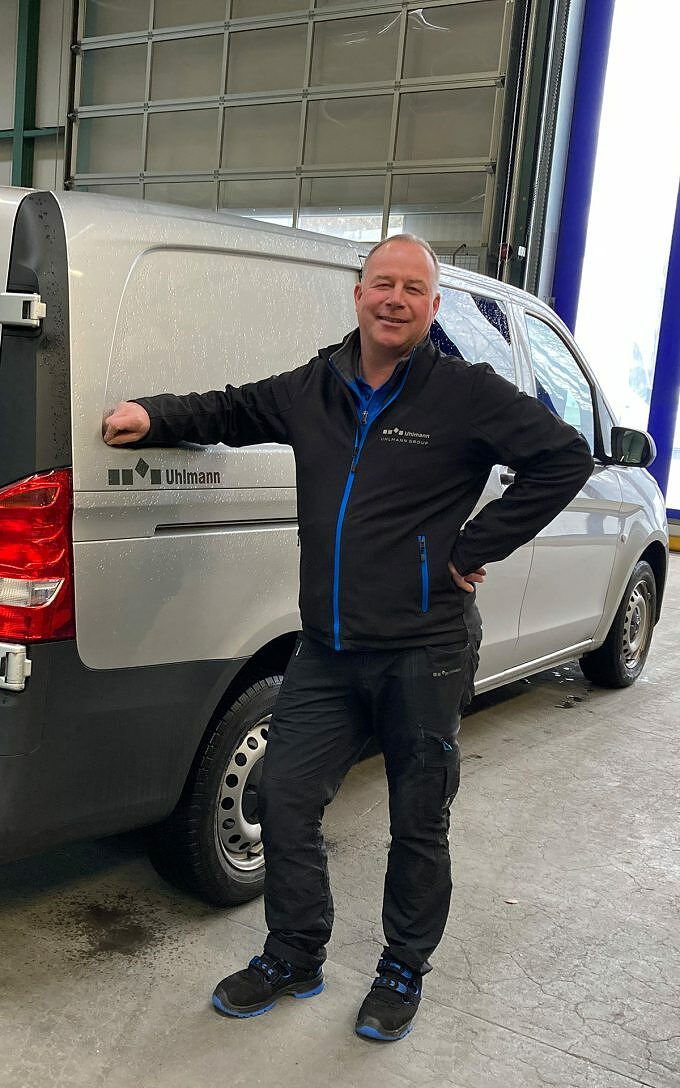
Frank Thimian, Driver Logistics Car Pool, District Youth Leader and Platoon Chief at the Laupheim Fire Department
How did you join the fire department and what is your position there?
I was “discovered” in 1993 by the commander serving at the time while watering the lawn. In 2003, I founded the Achstetten junior firefighter group which is the cornerstone of today’s Achstetten Fire Department. As district youth leader, I preside over all 46 junior fire departments in the Biberach district – that’s about 850 members.
How much time do you devote to your voluntary work?
Besides the missions, it’s about ten hours a week.
What motivates you?
Around 80 percent of youth firefighters actually join the fire department afterwards; that’s very motivating. Plus, my wife is also in the fire department.
What was your most satisfying experience in the fire department?
We were called out to an apartment where a stove had been left on and a small child left unattended. I’ll never forget the mother’s happy face once the danger was over.
What was your worst experience?
That was when my father-in-law’s farm burned down. Fortunately, nobody got hurt, but the animals perished. The whole operation took 32 hours.
Volunteer fire departments are immensely important, because you only usually find professional fire departments in large cities. Anyone who wants to join the volunteer fire department must be over 18 – or join the junior firefighters. Physical fitness is critical, as is a willingness to participate regularly in drills. Basic training lasts 70 hours. After that, firefighters can gain further qualifications, like becoming an engine operator (driver), a radio operator or a smoke diver. In operations, the team is hierarchically split up into incident commander, division commander, platoon leader, group leader and squad leader. This means that a supervisor does not have to take care of all emergency responders during a mission.
Image film of the Laupheim Volunteer Fire Departement