It’s hard to imagine Axito’s production floor without dashboards. And you only have to enter the Lauphein plant to see the first example of one of these large monitors. The one at the entrance shows the current KPIs of the facility, while others in the office area alert staff to any machine malfunctions. In the tool presetting area, the dashboard provides information about current machine utilization levels and any materials that staff need to provide. One hangs in the supervisor’s office and one in the mechanical production cell. And all these digital boards have a common purpose, as Serhat Toykan, Director Manufacturing at Axito, explains: “We want this digitalization to give us maximum transparency.”

We want this digitalization to give us maximum transparency.
Serhat Toykan, Director Manufacturing Axito
This transparency helps Axito achieve its targets. “The fact that our employees can see the visualized metrics themselves means they are directly involved in the process. That’s something that motivates them more than getting instructions from their supervisors. And if anyone comes and says they can’t reach their targets, we talk to them to find out why and thus engage in a problem-solving and improvement process,” says Toykan.
Using digitalization wisely
By reading the dashboards themselves, employees can find answers to issues that concern their own activity. For example: How did I perform in my production cell? How high are my rejects? How many error messages did I get, how long does it take me to rectify any faults? In addition, they show key operating figures, like on-time delivery, cost of non-quality, and output and utilization levels. They also provide information on the number of reportable work-related accidents. And all without having to manually edit MS Excel spreadsheets in the individual departments. “This saves time,” says Toykan, and goes on to say: “Thanks to the SAP Analytics Cloud, we can dispense with the manual process of preparing and presenting data, increase transparency for all employees, contribute to faster decision-making, and thus ensure the reliability of supplies across all steps of the process.”

Matthias Göttel, tool presetting, appreciates the overview of the orders and the tracking of the parts.

The direct stock can also be read from the board in the tool presetting.
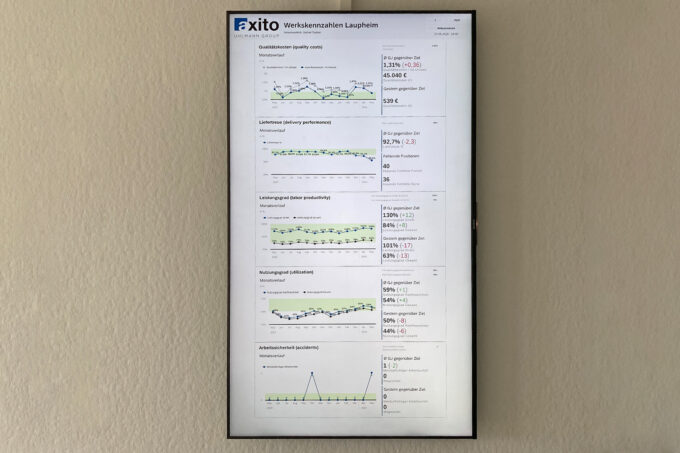
The board at the main entrance informs customers and employees about delivery reliability, performance level, quality costs and more.
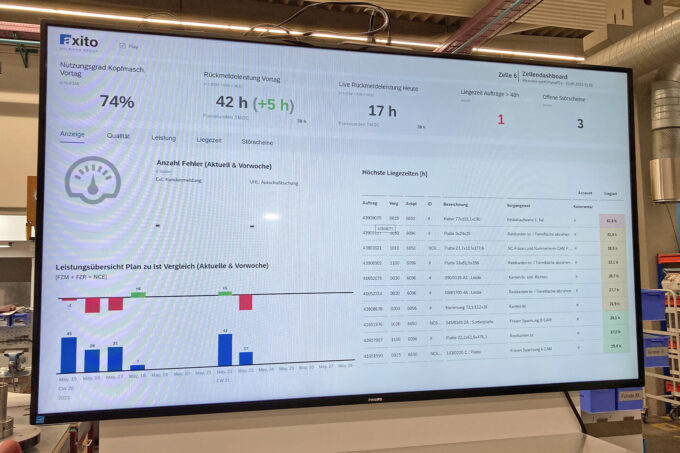
Colleagues in production can see at a glance on the board what the performance is like.
Axito gradually began introducing the dashboards at the end of 2021, and made sure that all colleagues were involved right from the start. The idea for the dashboard in the tool presetting area, for example, came from an employee. According to Toykan, the response to the boards has been correspondingly positive ever since. And Matthias Göttel from the tool presetting department adds: “The enhanced transparency of the orders ensures that the parts can be tracked. A fast response time for replacement tools is important and can thus be guaranteed.”
Nevertheless, as Toykan explains, we’re not using digitalization just for the sake of it. “Wherever it makes more sense to use paper, we’ll stick with paper. The overriding goal is to continuously improve our processes.” And even Axito can’t do without analog exchange: “Many conversations take place right near the dashboard hanging by the coffee machine,” says Toykan.
Help us improve.
Please rate this article:

 Loading...
Don't miss any stories!
Subscribe to the pactuell newsletter now to receive information on new articles directly in your inbox:
You can find more about the subscription and data protection here.